Beyond Belief – Think About It: Sighted Faith

“Love the Lord your God with all your heart, with all your soul, and with all your mind.”

Jesus, as recorded in Matthew 27:32 (NIV, emphasis added)

Who said you need to put your brain in neutral in order to believe in Jesus? Why is there this notion by those who are not yet followers of Christ that faith and thinking are mutually exclusive, or that ours is a blind faith?

To be fair, this idea is somewhat self-inflicted. According to Christian historians, this stereotype became prevalent because of some revivalist movements in America in the early 1800s. For example, J.P. Moreland explained in his book Love God with All Your Mind:

During the middle 1800s, three awakenings broke out in the United States: the Second Great Awakening (1800-1820), the revivals of Charles Finney (1824-1837), and the Layman’s Prayer Revival (1856-1858).  Much good came from these movements, but their overall effect was to emphasize immediate personal conversion to Christ instead of a studied period of reflection and conviction; emotional, simple, popular preaching instead of intellectually careful and doctrinally precise sermons; and personal feelings and relationships to Christ instead of a deep grasp of the nature of Christian teaching and ideas.  Sadly, as historian George Marsden notes, ‘anti-intellectualism was a feature of American revivalism.

J.P. Moreland, Love God with All Your Mind, p.23 (emphasis added)

In other words, these preachers pushed for an immediate conversion to Christianity, appealing to people’s emotions rather than their intellects to try to win them over. While there is certainly nothing wrong with an immediate conversion, nor with being in relationship with Christ, we must still over time develop an intellectual understanding of the claims Jesus made. Failure to do so will lead to a shallow faith that is in danger of withering under any sort of scrutiny, either internally or by others.

Jesus emphasized the importance of developing an intellectual understanding of his claims when he explained the Parable of the Seeds to his disciples in Luke 8:

“This is the meaning of the parable: The seed is the word of God. Those along the path are the ones who hear, and then the devil comes and takes away the word from their hearts, so that they may not believe and be saved. Those on the rocky ground are the ones who receive the word with joy when they hear it, but they have no root. They believe for a while, but in the time of testing they fall away. The seed that fell among thorns stands for those who hear, but as they go on their way they are choked by life’s worries, riches and pleasures, and they do not mature. But the seed on good soil stands for those with a noble and good heart, who hear the word, retain it, and by persevering produce a crop.”

Jesus, in Luke 8:11-15 (NIV, emphasis added)

Said another way, we can go back to the quote I started this post with, where Jesus stated it is just as important for us to engage God with our minds as it is for us to connect with him via our hearts and souls.

Ours is a sighted faith, not a blind one.

Does this mean we have to fully understand everything in the Bible before we can become a follower of Christ? Thankfully, no, or else that would be a very small group of people. Maybe just the Apostle Paul and C.S. Lewis. But we should always be investigating the claims made in the Bible to expand and deepen our intellectual understanding of God. This is how we build our faith on bedrock instead of sand. Here’s how Paul put it:

Borrowed from YouVersion: https://my.bible.com/verse-of-the-day/ROM.12.2/526?version=111

“By the renewing of your mind.” There it is again. And if you’ve spent any time studying and unpacking Paul’s writings–especially his letter to the Romans–you know he’s not kidding around when he says this. You need to have your thinking cap on when you’re wrestling with Paul!

By the way, referring back to my earlier mention of “blind faith”, I think Paul may also be admonishing people here not to have blind faith in the wisdom of the world or the age in which we live, either. In other words, just because a Hollywood celebrity or famous scientist or some random person on social media claims that it’s silly or outdated or superstitious to believe in God, that doesn’t mean we have to believe them. But just as I am saying we should investigate the claims in the Bible, we should approach their assertions with the same level of intellectual curiosity.

Another “by the way”: I recognize that I am using the Bible as a proof point for why we should believe the Bible, which is rather circular logic. I do plan on covering things like the historicity and validity of the Bible itself in an upcoming post. But I want to unpack these “beyond belief” concepts one at a time.

Anyway, there’s one last set of ideas I want to cover today. With this talk about investigating the Bible and intellectual curiosity, what do I mean by that? What does that look like?

Well, whenever you investigate anything to determine whether it is worthy of your faith (recall from last time that we all have faith, it’s just a matter of what we have faith in), you move through these basic stages:

  1. Evaluation – this is where you’re checking to see if the thing you’re investigating is worthy of your faith. Questions for this stage might include:
    1. Is this thing well-constructed? Recall the analogy of an airplane that I used last time. If you got onto a plane that was full of holes and generally seemed to be falling apart, would you stay on? Or would you head to the exit as quickly as you could?
    2. Is the thing you’re investigating logical? Does it make sense in its context? Meaning, does it fit within its operating principles?
    3. Are there multiple ways to check the validity of the thing you’re investigating?
  2. Confirmation – assuming you reach the conclusion that the thing you’re investigating is worthy of your faith, the next determination you would make is whether it meets a need for you. If you need to get to Toledo, OH, but don’t live anywhere near there, an airplane would be relevant for you. But if you don’t need to go to Toledo, or if you live nearby, you probably wouldn’t be interested in getting on an airplane to get there no matter how well-constructed it is.
  3. Acceptance – once you have determined that the thing you’re investigating is worthy of your faith and it meets a current need, you accept it. You demonstrate your faith by submitting to that thing you were investigating. You get on the airplane heading for Toledo.

So that’s it for today. As we move through these posts, we’ll see that Biblical faith is not blind at all. It is based on reason, logic, and evidence. It’s true that to become a follower of Christ requires taking a step of faith, but that step should be taken as much for intellectual reasons as for emotional ones.

Also, if you perform an honest, thorough, and intellectually curious investigation into the claims in the Bible, it would also take a step of faith to be an atheist. So being an atheist is not an absence of faith, it is faith in your ability to explain your belief that God does not exist.

With that, let me leave you with a few great quotes from C.S. Lewis related to this topic.

CS Lewis | Cs lewis, Lewis, Faith
Borrowed from https://i.pinimg.com/originals/8e/ec/45/8eec45c11fa6d671d952c0b8586e2116.jpg
Pin by Rebekah Johnson on Beliefs and Convictions | Cs lewis, Atheism, Evangelism
Borrowed from https://i.pinimg.com/originals/fa/d0/2f/fad02f940b89c88f83408d0714d02767.jpg
This CS Lewis quote totally DESTROYS atheist's logic - The Horn News
Borrowed from https://thehornnews.com/wp-content/uploads/2015/09/CS-Lewis.jpg
Posted in Christian, Faith | Tagged , , , , , , , , , , | 4 Comments

Bravery – Remembering September 11, 2001

Photograph & Quotation Copyright © 2021 by David K. Carpenter, All rights reserved
Copyright © 2021 by David K. Carpenter, All rights reserved

United, we stand.

Otherwise, we crumble from the inside.

Posted in Uncategorized | Tagged , , , , , , , | 2 Comments

Beyond Belief — Faith and Doubt

As we make our way into a series of posts on apologetics (explaining or defending your belief in Jesus), let’s start by exploring the foundations of faith and doubt. Before beginning today, I’d like to remind everyone that everything I say here I mean with utmost respect for those who are not yet followers of Christ, and I do not mean for anything I say to be insulting.

Starting with faith, I have heard non-believers saying they don’t have faith or they’re not a spiritual person because they “follow the science”. However, I’d like to point out that every time someone who “believes in science” accepts a scientifically proven fact without understanding the science behind it is really exercising faith. In other words, they believe that thing without fully understanding it. That’s faith.

Let’s take flying on an airplane as an example.

Photo by Ross Parmly on Unsplash

How many people who get on an airplane fully understand the laws of aerodynamics that cause a metal tube, which can weight in excess of 875,000 pounds (396,893 kg), to be able to lift off the ground and stay airborne? Without understanding that, everyone who gets on a plane expecting it to get them safely to their destination is demonstrating faith in that airplane and the science they don’t understand.

All of this is to make the point that there is no such thing as a person who does not have faith in something.

So then it comes down to the veracity of the things in which people put their faith. We will unpack the science and veracity of Biblical faith in upcoming posts.

Next, let’s look at the 10 most common root causes of why people doubt Christianity:

Photo by Md Mahdi on Unsplash
  • Believers behaving badly – sadly, this happens more than I wish it would, but if someone is treated poorly by followers of Christ, it can make that person bitter toward Christ himself, especially if there’s a pattern of such treatment. Even if people witness bad or hypocritical behavior by Believers that’s not directed at them, it can still turn them away from Jesus. For example, if a Believer shoots a doctor who performs abortions, what kind of message does that send to the watching world? Is this the way Jesus would have wanted us to act? Is it any wonder news media outlets devour stories like this?
  • Superficially believing that science and belief in God are mutually exclusive – there is, of course, nothing wrong with science, as long as its followers are willing to follow the scientific method. This means that they start with a hypothesis on a particular topic, then begin an open-minded investigation into the facts to determine whether or not their hypothesis is correct. I start with “superficially” here because I believe that people who reject Christ for this reason have not employed the scientific method in investigating the veracity of the Bible.
  • Apathy – this isn’t so much a root cause for doubting Christianity as it is for doubting the importance of Christ in the world or in our lives. However, the end result is the same–people in this category don’t accept Jesus as their Lord and Savior. As I’ve alluded to previously, this most closely identifies where I was when the Hound of Heaven found me.
  • Laziness – similarly, some people have a vague notion of the unbelievability of the claims of Christianity, but don’t make the effort to investigate them. I also think this applies to people who are dabbling around the edge of Christianity, some of whom may even consider themselves to be Believers. It is not for me to judge, so I am not, but my concern is that people like this may fall away from the faith at the first setback they encounter. They do not know the Peace of Christ that surpasses all understanding. Jesus never gave us the option to dance around the edges of following him–either you accept him as your Lord and Savior and receive his gift of grace so freely offered, or you remain in darkness. There is no in between. There must be a reason Jesus told the Parable of the Sower, as recounted in Luke 8:1-15.
  • Behavioral (on the part of the unbeliever) – some people are cynical or skeptical by nature. Others may have some sort of emotional baggage associated with the faith that keeps them away.
  • Egotistical – some people live under the illusion that they don’t need anyone else, including God. To believe in God would displace themselves at the center of the universe, and would mean handing over the keys to their fate to someone else. Similarly, sometimes this comes in the form of superiority, as in the sentiment that poor, little weak and stupid Christians are not as strong or as smart as they are since we believe in this supposed mythology.
  • Social / Social media – for people in this category, it is more important to be liked by their peers (or even people they don’t know) today than it is to ponder what happens to their soul in eternity. This is the very definition of the herd mentality.
  • Way of life – some people back away from the edge of the cliff of following Jesus because they are concerned they will have to change one or more things about their way of life, which they do not want to do.
  • Circumstantial – it’s quite natural for someone to whom bad things keep happening to question the existence of a loving God. That questioning is fine as long as it is followed by an honest and earnest investigation into the Truth. But unfortunately, often the notion of the existence of God is dismissed in people like this without investigating because they have the mistaken impression that God has promised us an easy life–so if their life isn’t easy, there must not be a God. There is no such promise in the Bible, which they would see if they investigated. In fact, like Jesus himself, most of his followers named in the New Testament were executed for their beliefs. Where in that story would anyone get the impression that being a Christ-follower means we should have an easy life?
  • Theological / Preferential – there are stories about God in the Old Testament that can make him seem like a monster, especially when taken out of context. People may latch onto those micro-pictures of God without stepping back to look at the broad, sweeping narrative that in the end shows how much God loves the world and everyone in it. They may point to these stories and say they don’t want any part of a God that is such a monster.

I’ll unpack and address the evidence and science behind the claims of Christianity in upcoming posts, but I wanted to lay this additional groundwork before jumping in.

Did I miss any major reasons why people reject Jesus? What have you encountered, or experienced yourself?

Posted in Christian, Faith | Tagged , , , | Leave a comment

Beyond Belief — Before the Beginning

Let’s remember for a moment back to the time before we passed through death of our old self and into our new life, our new selves. Was your journey toward rebirth simple and straightforward, or was it a prolonged wrestling match? Do you remember it as a single moment in time, as if someone (God) flipped a switch in you, or was it more evolutionary in nature, a gradual process that one day led you to realize that you had become a follower of Christ?

What was the foundation of your hope at that time before the beginning of your new life?

What questions did you have about God and life and Christianity? Where did you find the answers?

I’m going to jump into a set of posts on the topic of apologetics. For anyone new to the faith or unfamiliar with it, this does not mean, as the word seems to imply, that I am apologizing for being a follower of Christ. Quite the opposite, really–it refers to defending or explaining our faith. Not in a mean way, but in a way that meets people where they are to help them understand the truth, if they are earnest seeking to find it.

Perhaps one of the most interesting perspectives on this comes from people who were originally atheists–those who outwardly claim there is no God–but then ended up being believers. Here are a couple of my favorite books from people who fall into this category (note: these are affiliate links):

  • Surprised by Joy: The Shape of My Early Life, by C.S. Lewis. The same C.S. Lewis who wrote the “Chronicles of Narnia” and many other books started his faith journey as a vocal atheist who began investigating reasons to support his belief that there is no God. Over time, his readings led him to trade in his atheism for agnosticism, acknowledging “some sort of God as the least objectionable theory.” Next, he evolved into theism, but not yet Christianity–so he believed in God, but not yet Jesus. However, as he continued his investigation, God placed several believers in his life, the ultimate result of which was that Lewis himself became a believer, admitting, “That which I greatly feared had at last come upon me. In the Trinity Term of 1929 I gave in, and admitted that God was God, and knelt and prayed: perhaps, that night, the most dejected and reluctant convert in all England.” Lewis’ conversion story is so compelling because he had spent so many years as a non-believer and was dragged by God, kicking and screaming, into a relationship with Christ.
  • Case for Christ: A Journalist’s Personal Investigation of the Evidence for Jesus, by Lee Strobel, who was a journalist for the Chicago Tribune. Annoyed by his wife’s faith, he set out to apply his investigative journalist skills to disprove the existence of God so she would stop believing this nonsensical mythology. However, the course of his investigation led him somewhere else entirely–he ended up becoming a follower of Christ as a result. In the book’s introduction, he says, “But when I changed those lenses—trading my biases for an attempt at objectivity—I saw the case in a whole new light. Finally I allowed the evidence to lead me to the truth, regardless of whether it fit my original presuppositions.” Although he says this about his journalistic process relative to a criminal case he had investigated previously and not the conclusion he reached, it’s still an important point regarding his findings.

It’s worth noting up front, though, as I try to unpack some of the deepest questions or objections people have about God, Jesus, and the Bible, that at the end of it all, the final step in anyone’s journey into a relationship with our Creator is up to them. We can and should shepherd others along to help them process what they’re experiencing, and pray with/for them while they’re going through it, but ultimately it is up to them to take the leap of faith into the waiting, wide open arms of our Loving Father.

There’s something else to mention here. We must never condemn or judge (or act in any other distasteful way toward) anyone who is not yet a follower of Christ simply because they don’t understand or accept his message. For one thing, God must first soften their heart, making it fertile soil to receive and nourish the seed of his message. In other words, no matter how eloquent and patient and right you are, if God’s not in that effort with you, you will never convince them of anything.

For another thing, we make it harder for people to accept the message that God is a loving, caring Father if we chase after them with torches and pitchforks like an angry mob seeking an evil monster.

Remember grace. Remember that we were once as they are, where nothing about Christianity makes sense (What do you mean by “the blood of the lamb”? That’s disgusting!). Remember that we didn’t get to this point, to this relationship with Jesus, on our own merits. We were able to receive his gift of salvation only because he first softened our hearts, then put someone or something in our path at just the right time so we’d be open to exploring the depths of God.

And remember that Jesus characterized God as a good and patient Father who waits for all of us on his great big front porch, watching for his prodigal sons and daughters to realize the foolishness of their ways and come crawling to him. Remember that he loves them so much he won’t wait for them to reach his porch, but instead leaps off the porch and runs out to welcome them, his arms wide open, in the shape of the cross. (the Parable of the Prodigal Son, Luke 15:11-32)

That’s our God, and these are the people he wants us to help find their way home.

Posted in Christian, Faith | Tagged , , , , , , , , , , | 1 Comment

Whispers from God

How Jehovah’s Witnesses Caused My Relationship with Jesus

Someone commented on my last post, remarking on the believability factor of the Bible, for which I’m grateful. It made me think back on my own journey to relationship with my Lord and Savior.

I wasn’t raised in the church, and honestly, I didn’t really give it much thought. At least not until I started dating a girl in high school who was a Jehovah’s Witness. Even then, I didn’t give it much thought because she didn’t seem to be all that into it and she never seemed to mind that I wasn’t religious.

Our world came crashing down, though–or so it seemed (everything feels like a Shakespearean tragedy when you’re 17)–when her father announced that we could no longer date because I was not a Jehovah’s Witness. This made me consider the “easy” way out: I would simply become a Jehovah’s Witness. Problem solved, right? Of course, I had no idea what this meant.

So I set out to learn more.

This plan caused probably the biggest series of arguments I ever had with my parents. I mean, what right did they have to tell me what I could or could not do when it came to religion since they were not religious themselves??

We finally reached a compromise that I could go to a Jehovah’s Witness meeting after I attended three services at “mainstream” Christian churches. This seemed reasonable, so I agreed.

One thing I had been told by the Jehovah’s Witnesses as they sought to bring me into the fold is that they are different from other churches because they believe Jesus is an angel, not that he is part of the triune God. In other words, they did not believe in the Trinity, whatever that meant.

So when I went to my first service at a “mainstream” Christian church, you’ll never guess what the topic of the sermon was.

The Trinity.

Weird, right?

I have to admit that the sermon’s explanation of the Trinity didn’t make a lot of sense, but it at least resonated with me enough that I thought it was worth exploring further. (And now, all these years later, on some days, there are still aspects of it that are hard to explain!)

Anyway, at the time of that sermon, I thought it was the strangest coincidence. But now, as I’ve mentioned before, I don’t believe in coincidences. I do believe, however, that God works in our lives even before we know who He is, and that the things He does are often beyond what we can understand. So that’s why we’ve invented human terms like coincidence and karma, to explain the unexplainable that only God understands.

I’ll spare you all the sordid details, but suffice it to say that this is the highlights version of my story of how the Jehovah’s Witnesses unintentionally led me to accepting Christ as Lord of my life.

The Need for Answers

What’s the point of all this?

Well, for one thing, I think it’s helpful for us to remember back to a time when none of the Biblical stories made sense to us. This may help us to relate in more meaningful ways and in “normal” language to those we encounter who don’t understand or believe any of it. It can also help us deepen our own faith if we challenge our own long-held understanding or assumptions about certain topics and then explore for better answers.

For another thing, there’s something that draws us humans into the search for answers. We all want and need to believe in something. Even those who claim to have no religious beliefs put their faith in science or some such thing (which is not to say that a belief in God and a belief in science have to be mutually exclusive).

Interestingly, as an example, I was recently talking with a good friend of mine who I thought was a life-long atheist. I asked him this about statements he had made previously indicating a posture of gratitude for the blessings in his life: “When you say you are grateful for your blessings, who are you grateful to?” (I know the grammar isn’t quite right there, but I always feel sort of snooty saying “whom”. I mean, who talks like that any more (or is it “whom”?)? He thought about it for a minute and said that he doesn’t really consider himself an atheist any more. He thinks about it like there’s a great spiritual force out there, which he usually refers to as “the universe”. I told him we call that great spiritual force “God”, but left it at that for now.

Anyway, to bring this thing in for a landing, I think it is God himself that plants in all of us the desire to search for answers, even though he knows he is the ultimate Answer to all our questions. He also gave us free will to decide for ourselves what we think the right answers are to life’s biggest questions. If he had done otherwise, if he had not given us free will but rather compelled us to believe in him, it would not be belief at all, but rather a mindless acceptance of a dictator’s demands. And this would be a terrible foundation for the loving relationship he desires to have with each of us.

So whether we recognize it or not, it’s a God-given blessing that we are allowed to believe he doesn’t exist. Isn’t that strange?

But that’s OK, it’s not important to God that his ways always make sense to us, as the Prophet Isaiah passed along in a quote from God:

“As the heavens are higher than the earth, so are my ways higher than your ways and my thoughts than your thoughts.”

Isaiah 55:9 (NIV)

So back to the “believability factor”, I wanted to mention that I’m planning to address some aspects of this in upcoming posts. My friends, if there are any unbelievable topics you’d like me to help unpack for you and with you, please leave a note in the comments.

In closing, I’ll share a poem I wrote that ponders the question of where we got the need for answers.

Whispers from God

What rustles and stirs
The core of your deepest self?

The sun sinks beneath the western 
Edge of your world, 
Flinging golden rays heavenward
As the sky remains undecisive:  
Azure, orange, red, violet?

Emerald forest after rain glistens,
Hailing its reunion with sunlight.
The scent of a thousand layers
Of decaying trees is somehow clean,
Refreshing, inviting, soul-nourishing.

A child is born, a new
Tiny human completely
Dependent on you to survive.
Instantly you love your daughter, son,
But they don’t love you, 
They don’t know you. Not yet.
But they will
In their own way,
In a thousand moments to come.

A stranger stops to help a new friend
Change a flat tire in the snow.
A stranger volunteers to feed new friends
At a soup kitchen.
A stranger puts an hour’s wage
Into the hat of a new friend who is unable to 
Find work or a home 
So that person can live another day.

Longings, whispers from God:
For beauty, for deep inexplicable peace,
For love and belonging, 
For life the way it’s meant to be.

Who gave us these?
The universe? Evolution?
Who has set eternity in our hearts,
If not the One who made us
To be eternal?

Copyright © 2021 by David K. Carpenter
All rights reserved
Posted in Christian, Faith | Tagged , , , , , , | Leave a comment

Working for God, Inc.

Don’t You Have to Be a Pastor to Serve God??

When I first became a follower of Christ, I was young and foolish and in high school. At the time, I was trying to decide what to major in as I was preparing to launch into college and from there, into the rest of my life. A heady challenge for a 17-year old. Anyway, for a brief period of time, I had made up my mind to become a pastor, maybe because a youth pastor had helped me navigate the thorny path I was hacking my way through in order to find answers to even more important life questions, such as:

  • Who is God? Is He important in my life? If so, why?
  • How do you count Him? Is he one or is He three? And why does that matter?
  • Why have so many rotten things been done in His name? Are those things His fault?

OK, well, now that I’ve brought these little questions up, I’m going to move on since they are beside the point I’m wandering toward.

So, what is the point? I’ll get there, but the reason I bring up this decision to become a pastor is because at the time, when I was a baby Christian, I thought you needed to work as a pastor in order to serve God with the abilities He gave you. I chuckle at that naïve notion now (like so many things I was convinced of in high school).

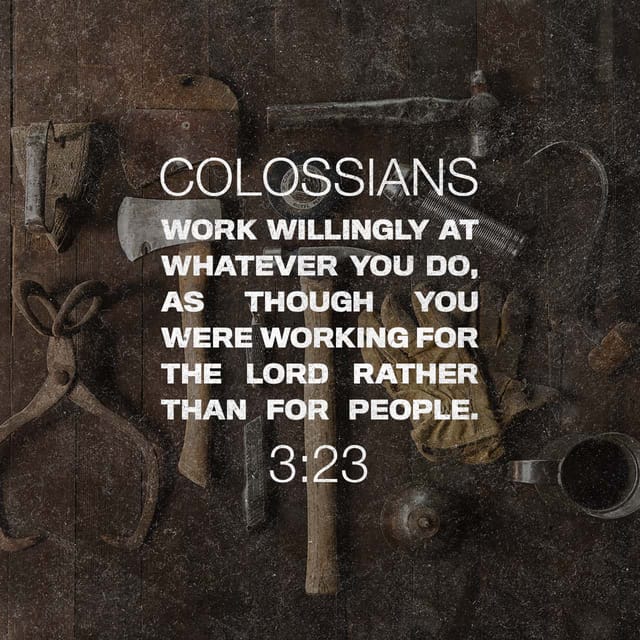
What I’ve learned since is that God does in fact want us to use the skills, abilities, experiences, and opportunities He has given us to serve Him wherever He has placed us. This does not have to be in a job that appears to be related to the church in any way. In fact, the Apostle Paul wrote about this on several occasions, including:

Borrowed from YouVersion: https://my.bible.com/verse-of-the-day/COL.3.23/56515?version=111

And:

For just as each of us has one body with many members, and these members do not all have the same function, so in Christ we, though many, form one body, and each member belongs to all the others. We have different gifts, according to the grace given to each of us. If your gift is prophesying, then prophesy in accordance with your faith; if it is serving, then serve; if it is teaching, then teach; if it is to encourage, then give encouragement; if it is giving, then give generously; if it is to lead, do it diligently; if it is to show mercy, do it cheerfully.

Paul, in his letter to the Romans (12:4-8, NIV)

At some point in my career and growth as a Christ-follower, these truths became evident to me. Ever since then, I have tried my best to work and lead in my secular jobs in a way that glorifies God and, in my own little way, further advances God’s Kingdom here on earth. Like the saying goes, What people see in me may be the closest thing some people see to the Bible. If that’s the case, I realized, I’d better make sure that my treatment of people is interwoven with the same respect and love that Jesus showed them when He died on the cross for them before they even knew Him.

It’s a tall order, for sure, and impossible for someone like me to carry out on my own, so I thank God for His grace and patience with me every time I fall short. And I am learning to thank Him also for putting me in difficult and challenging situations, giving me greater opportunities to depend on Him to bring me through them while (hopefully) looking more like a light in the darkness than the darkness itself.

Wait, you mean thank Him for tough situations? Well, yeah. Nobody (especially not God) ever said this would be easy. And I did say I’m still learning…

Anyway, all of this is my way of meandering to the answer to my initial question: No, you do not need to be a pastor to serve God. We all can and should serve with excellence wherever we are working as though we work for God. You never know how or when or with whom God will use our meager offerings to bring someone with into relationship with Him.

Caution: Be Careful What You Ask For

There’s something to keep in mind here, though. If you pray about serving God, His answer may not be what you expect (which is true of any conversation we have with God). Sure, it might just be helping you to keep doing what you’re doing, only better (since you’re doing it for God’s glory). But God may also take you places or into roles you never anticipated.

Think about it. Jesus turned fishermen and a tax collector into authors, leaders, and preachers, none of which had probably been part of their career plans. He took a Pharisee who was trying to kill Christ followers and turned him into the most prolific author in the New Testament, proclaiming the very Gospel he had been trying to eradicate.

God’s answers to our prayers often look strange to us. But that’s OK with God, even if it makes us think He’s not answering.

So just be aware that when you talk to God about this, He just might answer you! So buckle up and enjoy the exciting ride into the unknown!

Perspective from a New Friend

The term “God, Inc.” was brought to my attention (and possibly coined) by someone with whom I have recently become acquainted, Chad Burmeister. I thought I’d take a moment to write about him and how he approaches this idea of working for God in the secular workspace (so it’s not just me talking about my experience with this).

As one of the most recent steps in his distinguished career trajectory, in 2017 Chad founded and is CEO of ScaleX.ai, which offers a tool leveraging artificial intelligence (AI) to help companies of all sizes grow sales. I recently had an opportunity to interview him for a side business I’m working on. As it happens (well, actually, I don’t believe in coincidences, so it must be a God thing), some of his answers fit in well with this blog, hence my reason for bringing him up here.

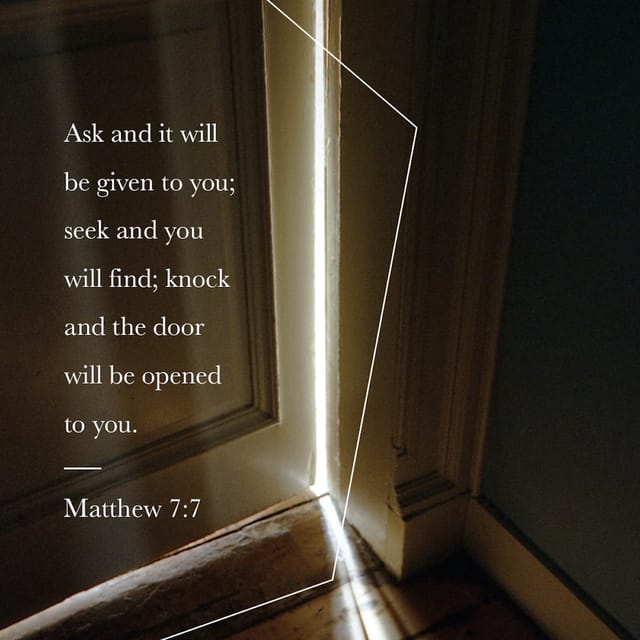
Although Chad serves God faithfully in his secular company, he also felt called to start up two additional faith-based companies. The first is a non-profit and podcast called “Living a Better Story“, which asks the question, “You’re living a good story, but what if you could be living a better one?” The second is a recently launched and exciting mobile app called 77Pray, which is creating a network of followers of Christ encouraging and praying for one another with the goal of growing closer to God. The “77” refers to Matthew 7:7:

Borrowed from YouVersion: https://my.bible.com/verse-of-the-day/MAT.7.7/46342?version=111

I have downloaded the app and subscribed. It’s really exciting to see Believers networking in this way and for this purpose! It’s definitely worth checking out. Go Chad!

Anyway, as you can imagine, I have developed a great deal of respect for my new friend Chad. Here are a few of the really cool thoughts Chad shared with me in our interview which, among other things, inspired me to publish this particular blog (all quotes are copyright © 2021 by Chad Burmeister).

When I asked him about living out his faith in the secular business world, this is how he responded:

There are people who want to see you succeed and those who want to see you fail (it must make them feel better). To me, when you focus on listening to God, and doing work for his Kingdom (heaven on earth), and when you see things happen for his glory, it’s truly rewarding.

Chad Burmeister

I love that, “when you see things happen for his glory, it’s truly rewarding”. How’s that for a performance bonus? When I asked him how he came to be someone who takes action to shape his life into what he wants it to be and why he thinks others don’t do that, he said,

God didn’t create everyone to take action. He created all of us with unique traits that can be leveraged into the whole. That said, what I’ve found is that it helps to 1) complete your past, 2) tell the truth about your current reality, and 3) live a better story. Many of us live in the past or worry too much about the future (me included). Living A Better Story was purpose built to help people solve for that.

Chad Burmeister

Finally, I asked Chad what he looks forward to in the future. This was his response:

Working for God. When you work for a company, or even yourself, it’s not as rewarding as knowing you are employed by God, Inc. Seriously, think about that for a minute. I’ve interviewed 50+ people on the Living A Better Story podcast, a few of them said they actually “work for God”. I love the sound of that, and so now I do too!

Chad Burmeister

Obviously the term “God, Inc.” really resonated with me since I named this blog post after it!

So that’s it for today. We should all go forth and do great things to further the advance of heaven on earth in the service of the most loyal and sacrificial boss ever!

Posted in Christian, Faith | Tagged , , , , , | 8 Comments

There’s Only One Metahuman

A guy I connected with recently in association with my “day job” and other endeavors recommended that I read Deepak Chopra’s book, “Metahuman“. My new friend is a very smart guy and is also a follower of Christ, so I took up his suggestion. I finished the book today, and immediately afterward, felt compelled (maybe called by God?) to write about it in my blog post for the week. So here I am. And I think there’s a reason why I felt compelled to write about, which I’ll explain in a little bit.

I found the book to be engaging and challenging (meaning, not for the faint of heart and not a light read to wrap up your summer reading list). Dr. Chopra’s basic assertion in the book is that whether we realize it or not, we are all part of a universal consciousness, which is responsible for the creation of actual reality. This is in contrast to what he refers to as the virtual reality in which we generally live and allow ourselves to accept as true reality. Dr. Chopra invites readers to awaken from our virtual reality, and in so doing, open the door to becoming “metahuman” (leveraging the Greek word, “meta,” which means “beyond”), which is to say that we tap into our unlimited potential via our connectedness to this universal consciousness.

As a child, Chopra attended Catholic school in New Delhi, India. Being in India, he also learned the Indian traditions and Hindu stories. And in the process of studying to become a medical doctor, he naturally engaged in a great deal of scientific learning and research. Interestingly, though, his mystical and metaphysical approach that led him to this idea of a universal consciousness flies in the face of Christianity, Hinduism, and even the modern-day religion of science.

For anyone who has seen the movie “The Matrix”, the journey to enlightenment Chopra describes in this book feels like the red pill/blue pill speech that Morpheus gives to Neo.

Borrowed from Pinterest: https://i.pinimg.com/originals/f3/a9/83/f3a9835cf584a51d4ce35bc1edc32948.jpg

I actually think Chopra has a lot of great ideas in this book. I believe there is something like a universal consciousness that can help us live beyond ourselves and achieve great things we never thought possible. But here’s the thing: we call that God.

There have been countless documented cases of people tapping into God’s power through prayer and accomplishing supernatural outcomes, which we call miracles.

Chopra joins others from secular society who lump Christianity in with all other world religions, which they characterize using terms like old-fashioned, superstition, and mythology. But these are people who, if they have even bothered to investigate that which they seem to have all figured out, may have learned about God, which misses the mark entirely. It is less important to God that we know all about Him than it is that we know Him. Ours is not a God whom we use to magically explain all the things we don’t understand. In fact, anyone who knows Him knows that it’s not really important to Him that we understand the world or everything He is up to.

“For my thoughts are not your thoughts,
neither are your ways my ways,”
declares the Lord.
“As the heavens are higher than the earth,
so are my ways higher than your ways
and my thoughts than your thoughts.”

Isaiah 55:8-9 (NIV)

The previous paragraph sounds much more bitter than I had intended. I just can’t think of a good way to make my point without using such stark language. I have to confess, as a human being, I sometimes get frustrated with the way secular society characterizes followers of Christ as morons who are stuck in the dark ages. But this blog is not a place for me to express my grievances; it is meant only to be a place where I encourage Believers (including myself) with the messages God puts on my heart. So I am calling myself out here the way Jesus would, quoting the verses immediately preceding the one I just included above:

Seek the Lord
while he may be found;
call on him while he is near.
Let the wicked forsake their ways
and the unrighteous their thoughts.
Let them turn to the Lord, and he will have mercy on them,
and to our God, for he will freely pardon.

Isaiah 55:6-7 (NIV)

OK, so I am reminded that I need to pray for people who haven’t yet turned to God.

Returning to “Metahuman”, in my humble opinion, the biggest problem with this book is that Chopra is inviting people to tap into the spiritual power of the universal consciousness (God) without the knowledge of good and evil that only God possesses. The enlightenment one achieves in the process of becoming metahuman knows no morality since the concepts of good and evil are human constructs created to govern what he refers to as the virtual reality we all inhabit. This is scary.

It didn’t go so well for that last one who tried to call himself equal with God without being “weighed down” by morality. God changed his name from Lucifer to Satan and kicked him and his buddies out of heaven. Here is someone who had celebrated being in the presence of God with the other angels, but in the end he wanted the power of God more than he wanted to be in relationship with God.

That’s how strong the allure is of trying to achieve this god-like state.

But does this mean that God does not want us to tap into His great power? Certainly not!

He sent us His Son, the only true metahuman who is at the same time just human, to show us how to tap into God’s power simply by being in relationship with Him. Jesus didn’t use magic tricks–he used prayer to tap into the Father’s power. Here’s an example when he raised Lazarus from the dead:

Jesus looked up and said, “Father, I thank you that you have heard me. I knew that you always hear me, but I said this for the benefit of the people standing here, that they may believe that you sent me.”

Jesus, in John 11:41

And he told us that we can do the same thing:

“Truly I tell you, if you have faith as small as a mustard seed, you can say to this mountain, ‘Move from here to there,’ and it will move. Nothing will be impossible for you.”

Jesus, in Matthew 17:20 (NIV)

“Very truly I tell you, whoever believes in me will do the works I have been doing, and they will do even greater things than these, because I am going to the Father. And I will do whatever you ask in my name, so that the Father may be glorified in the Son. You may ask me for anything in my name, and I will do it.”

Jesus, in John 14:12-14 (NIV)

So that’s it. This is why I felt compelled to write this post today. Jesus is the only true metahuman, but he can guide us safely on the path toward a faith that enables us to tap into the power of God. That is awakening; it is the true enlightenment this world needs.

The question is, who will take the red pill so they can understand the Truth?

Posted in Christian, Faith, Miracles | Tagged , , , , , , | Leave a comment

The Power of One + God

This post serves as an exclamation point of encouragement to follow my submissions over the last two weeks, in which I talked about the challenge of trying to be God’s light in the darkness of this world when we can’t even get out of our own way. The goal of this blog, after all, is to both challenge us (myself included) and to encourage us (also inclusive of me) as we take up the tall order of trying to bring God’s blessings to those we encounter in our daily lives. So I want to make sure to serve a healthy dose of encouragement today.

And here’s the thing: God takes every offering we give, no matter how meager or faulty or awkward, and multiplies it for His greater purposes. He polishes it, patiently smoothing out the rough edges to create a work of art greater than what we could have done on our own.

We are all incomplete jigsaw puzzles. God, in a combination of His great power and His great love for us, fills in all the missing pieces to make us whole. This is God’s plan to help each of us limp across the finish line of this broken world carrying all of our hurts and fears and other imperfections until we are renewed and restored in His presence to who He intended us to be.

The Apostle Paul describes it like this in his second letter to the church at Corinth. He mentions the mysterious thorn in his flesh, which he asked God three times to heal. This is the response he received from God:

Borrowed from YouVersion: https://my.bible.com/verse-of-the-day/2CO.12.9/2190?version=111

And in a very typical Paul fashion, this is the conclusion he reaches:

Borrowed from YouVersion: https://my.bible.com/verse-of-the-day/2CO.12.9/24414?version=111

All this is to say that God’s power is more than enough to work in us and through us despite whatever frailties or other limitations we bring to the equation. Thank God for that!

Here’s how Paul summarizes this great news in another of his letters:

Bible Verse of the Day - day 214 - image 472 (Philippians 4:13)
Borrowed from YouVersion: https://my.bible.com/verse-of-the-day/PHP.4.13/472?version=111

Moving back in time to the Old Testament, the Prophet Isaiah also had something to say about God’s power and strength working in and through us when we serve Him:

Borrowed from YouVersion: https://my.bible.com/verse-of-the-day/ISA.40.31/393?version=111

OK, one more quotation about this, but this time not from the Bible. It comes from a Christian author I enjoy, Annie Dillard:

Why do people in church seem like cheerful, brainless tourists on a packaged tour of the Absolute? … Does anyone have the foggiest idea what sort of power we blithely invoke? Or, as I suspect, does no one believe a word of it? The churches are children playing on the floor with their chemistry sets, mixing up a batch of TNT to kill a Sunday morning. It is madness to wear ladies’ straw hats and velvet hats to church; we should all be wearing crash helmets. Ushers should issue life preservers and signal flares; they should lash us to our pews. For the sleeping god may wake someday and take offense, or the waking god may draw us to where we can never return.”

Annie Dillard, Teaching a Stone to Talk: Expeditions and Encounters (New York: Harper & Row, 1982), pp. 40-41. With thanks to PaulVK, in whose blog I located the version of this quote I like best.

Here’s the bottom line: if we make ourselves living offerings to God–which is really just another way of saying that we do everything in our daily lives in such a way that it glorifies Him and shows Him our gratitude for all that He has done for us–He will take what little we have to offer and multiply it many times over. So we don’t have to worry about our own strength (or lack thereof), but rather we can depend on God’s power to achieve great things for His kingdom through us!

How great is our God??

Posted in Christian, Faith | Tagged , , , , , , | Leave a comment

Light in Our Own Darkness, Part 2

Yes, God whispers. But although He may not usually speak loudly to us, He will sometimes whisper the same thing to us twice. Or three times. Or three thousand.

Until we finally catch on.

He’s patient that way. And maddeningly polite–where we would like for Him to whack us on the head with an umbrella and shout into our ears the answers to our prayers and explanations for all the other stuff that doesn’t make sense, He instead forces us to focus on Him, to concentrate on discerning His quiet voice through the din and clanging of this world. This is our God, who chose to speak to Elijah in a still small voice instead of a mighty wind, earthquake, or fire (1 Kings 19:12).

I’ll apologize in advance for taking such a meandering path to get to my point today, but writing the previous paragraph reminded me of a very old Swedish man I played chess against a long, long time ago in a place far, far way–sometime in the last century, in fact, in a fabled land known as California. This ancient Swede had lost most of his teeth, and maybe even most of his English words. He spoke animatedly to me during our match. Trouble was, I could hardly make out a word of what he was saying. OK, here’s a confession long overdue: I really didn’t understand anything he said. Not a mumble. I wasn’t convinced he was actually even trying to speak English. So I politely nodded my head and laughed occasionally, trying my best to give the impression that I was fluent in toothless Swedish muttering.

Anyway, here’s the point of that little detour: how often do we politely nod and laugh occasionally to try to give the impression that we are fluent in the whisperings of God?

And, actually, that’s not even my point for today. Here’s where I was going with all this: I think, but I can’t be sure, that God whispered something to me week, and I believe I am supposed to share it here with you.

Last week I wrote about the dark rivers we all have running through our hearts. And try as we may, we can’t seem to vanquish them altogether, due mostly to our fallen nature, and with slimy assists from Satan, who would like nothing more than to knock us off our trajectories toward heaven.

person standing and looking at moon
Photo by Tony Detroit on Unsplash

Then this past week, in my journey through the Bible with Brian Hardin and the Daily Audio Bible family, one of the readings included Romans 7. This is the passage where Paul–the Apostle Paul, who wrote at least half of the New Testament–laments about his sinful nature:

We know that the law is spiritual; but I am unspiritual, sold as a slave to sin. I do not understand what I do. For what I want to do I do not do, but what I hate I do. And if I do what I do not want to do, I agree that the law is good. As it is, it is no longer I myself who do it, but it is sin living in me. For I know that good itself does not dwell in me, that is, in my sinful nature. For I do not do the good I want to do, but the evil I do not want to do—this I keep on doing. Now if I do what I do not want to do, it is no longer I who do it, but it is sin living in me that does it.

So I find this law at work: Although I want to do good, evil is right there with me. For in my inner being I delight in God’s law; but I see another law at work in me, waging war against the law of my mind and making me a prisoner of the law of sin at work within me. What a wretched man I am! Who will rescue me from this body that is subject to death? Thanks be to God, who delivers me through Jesus Christ our Lord!

So then, I myself in my mind am a slave to God’s law, but in my sinful nature a slave to the law of sin.

Apostle Paul in Romans 7:14-25

So what’s the message here? There are 2 key points:

  1. Although God would never wink and look the other way while we sin, He does remind us here that even someone as great as Paul grappled with the dark river running through his heart. Meaning, even though we should seek His help to turn away from sin, when we do give in to our sinful nature, we should remember to turn to God in confession. And when we do that, we should forgive ourselves because He has forgiven us. But remember, we cannot take this as a carte blanche pass to keep on sinning (Paul talks about this as well).
  2. Although God would never wink and look the other way while we sin, He does ultimately deliver us from the eternal punishment we deserve by the sacrifice of Jesus Christ our Lord! I know this theme is sort of woven through item #1, but it’s such important great news that it bears repeating on its own.

So that’s it, the good news–the Gospel–boiled down to its core: God loves us so much that He gave us a ticket out of our vicious cycle of sin, at the cost of His own Son. We have only to accept the gift of grace and mercy.

book of John page
Photo by James Coleman on Unsplash

If this offer to save us from ourselves doesn’t convince this ailing world how much God loves us, I don’t know what will.

Posted in Christian, Faith | Tagged , , , , , | 1 Comment

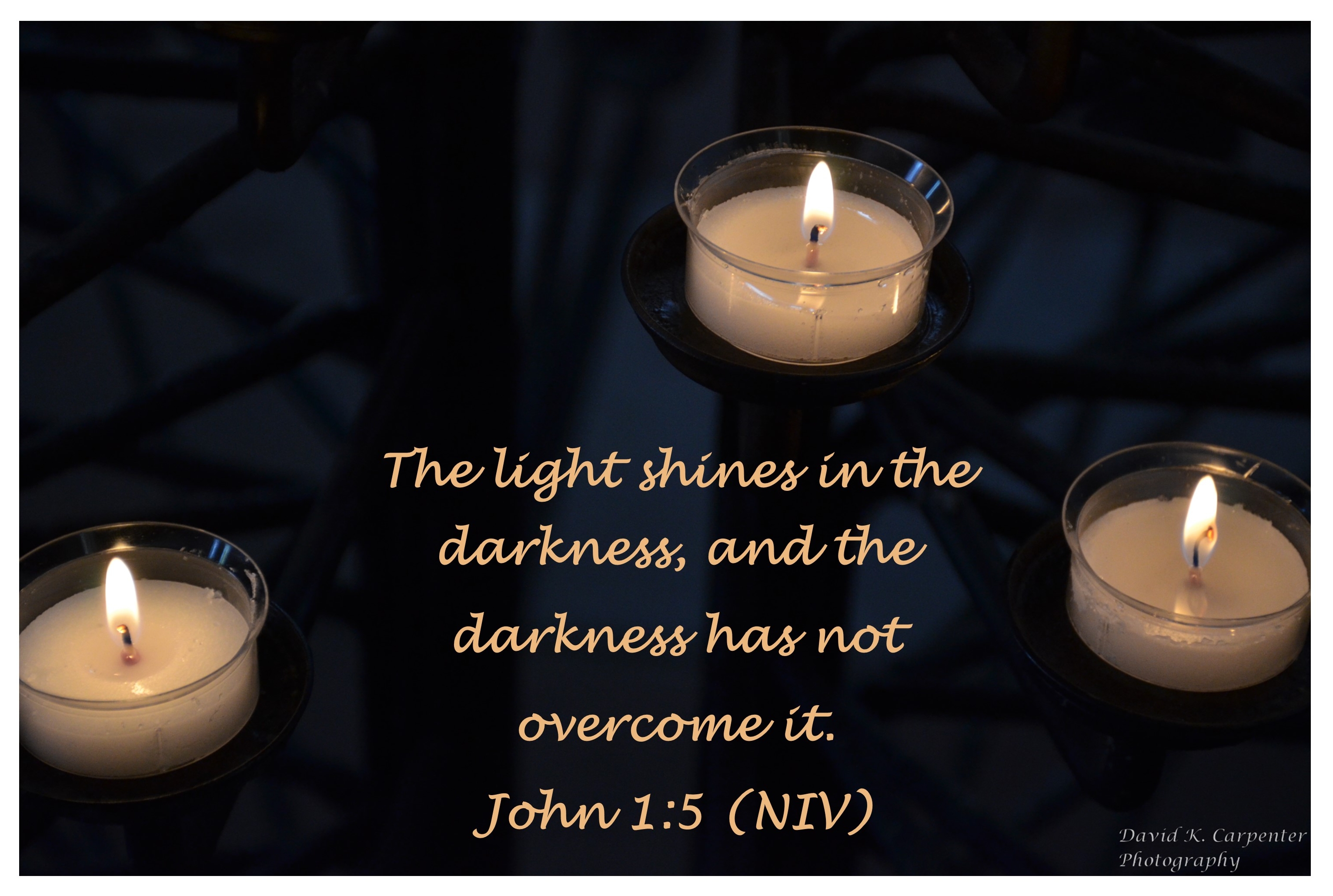
Light in Our Own Darkness

We are called by our God to, each in our own way and as His ambassadors, be a light in the darkness of this world. The good news–and at the same time, the challenge–about this is that we each are imperfect reflections of our all-powerful and always-perfect God. Jars of clay who have been dashed against the stone floor of our sin and brokenness and are slowly being rebuilt into something more closely resembling Jesus.

So, hopefully, we try to be God’s light in the darkness at our workplaces, in our neighborhoods, on social media. For our friends and, yes, even (or especially!) with our families. Sometimes we succeed in clear and direct ways, small and large. Other times we crash and burn–or think we do–and perhaps wonder why we even tried. Maybe God can’t use me after all…

But here’s the thing:

  1. God loves to work through people who seem to be unlikely conduits of His Love, Grace, or Action. Moses was a murderer. King David was, too, and added adulterer to his resume. Jonah really didn’t want to help the people of Nineveh be saved from destruction. The Apostle Peter was so impetuous, he seemed to act first, then think later. Paul tried to do away with followers of Christ. Yet God used all of these people in powerful ways. If He used them, He can use you and me. It’s not about what we can do, it’s about what God can achieve working through us when we cooperate with him.
  2. God can take our failures and work beautiful miracles through them. So even though our efforts may not lead the the outcomes that we expected, they can lead to the outcomes God intended, which is better in the end anyway.

OK, so all this so far is about us being imperfect, flickering candles illuminating the darkness in the world around us.

But what about the darkness that wells up all to easily within us? We each have dark rivers flowing within our hearts. And to be clear, I’m not pointing the finger at any individual–this is all of us, including me. Jesus was the only perfect human being who ever lived. So the rest of us are stuck battling it out in the gap between who we want to be and who we really are.

I am trying my hardest, begging for help from God, to be a better human, the person He sees me become when I reach my final destination, in His presence. Some moments of some days, I feel myself growing in that direction, I feel Him working in me and through me, drawing me closer to Him.

But then there are other moments… I sometimes think to myself, How could I be so close, walking in lock-step with God one moment, only to get distracted and fall away a few moments later?

That’s the evil one at work. A lion, as Peter put it, prowling around looking for someone to devour (1 Peter 5:8). The master deceiver, he is quite skilled at distracting us from our mission of loving God and loving others. And he should be good at it–he’s been at it for thousands of years, starting with Adam and Eve in Eden.

It would help us all to remember that the closer we become to resembling Jesus, the more the enemy hates that. So the more he will attack us to try to knock us off the narrow road toward heaven and God’s presence upon which we now journey. The sobering flip side of this is that if you don’t feel under some sort of spiritual attack by the evil one, it may mean the he doesn’t see you as a threat to his kingdom of darkness.

But make no mistake: we cannot use that as an excuse for bad behavior, for giving in to sin. As Jesus’ brother James warns us:

Borrowed from YouVersion: https://my.bible.com/verse-of-the-day/JAS.4.7/651?version=111

So what are we to make of this pickle we’re in? We want to stay close to God and bring his Light to the darkness of the world, yet we struggle with the darkness within us, which threatens to undermine our closeness to God and anything we try to do in His name.

Well, for one thing, here’s some good news for us: God’s grace and love abound. They are more than enough to cover ALL of our imperfections and failures as though they never happened. There is nothing that makes gratitude overflow from my heart more than that. He takes our feeble, inept attempts at shining His light in the darkness and turns them into floodlights illuminating His glory and compassion for this world.

lighthouse photograph
Photo by Clement Souchet on Unsplash

There’s a Japanese saying I like: “Fall Down Seven Times, Get Up Eight.” Borrowing that for the purpose of my message here, picture God saying to us, “Sin seven times, be forgiven eight.” God’s love and mercy for us overflows whatever we can ask or imagine.

left human palm close-up photography
Photo by Dyu – Ha on Unsplash

And here’s one more thing. I have sometimes wondered why God doesn’t allow those of us who want to live in close relationship with Him to stop sinning once and for all. I mean, why wouldn’t God want to grant us this request? Evidently, King David wondered something similar to this when he wrote Psalm 139:

Borrowed from YouVersion: https://my.bible.com/verse-of-the-day/PSA.139.24/697?version=111

He follows this up with the request, “See if there is any offensive way in me, and lead me in the way everlasting.” (Psalm 139:24 (NIV))

Here’s my theory about this: I believe that if God granted our request never to sin again, we would eventually end up believing that we ourselves are responsible for our sinlessness instead of giving God the glory and thanks for that.

And here is why I believe this. When His people were wandering in the desert for 40 years, as recounted in Numbers, God gave them manna to eat, but only enough for one day at a time. Jesus, in giving us the Lord’s Prayer, taught us to ask for our daily bread. I think that at least part of the reason He gives us things only in small doses is to help us remember that He is the only source of Life and everything glorious and worthwhile that we have. This helps us resist the temptation to believe that we can achieve anything important and eternal without Him.

That, my friends, is a blessing, since it keeps us aware of how much we need God. He’s much better at being God than we are!

Posted in Christian, Faith | Tagged , , , , , | 2 Comments