Through the Cracks

Introduction

Life has a way of breaking us. We’ve all experienced moments when we feel shattered, like everything we thought we could rely on has crumbled, and we’re left trying to pick up the pieces. It’s easy to feel hopeless in those times, like nothing will ever be the same. But the good news is, God has a way of putting us back together—often in ways that make us even stronger, even more beautiful, than we were before.

Recently, I’ve been reflecting on this truth through the lens of an ancient Japanese art form called Kintsugi. Kintsugi means “golden joinery” or “to patch with gold.” It’s a centuries-old practice that originated in Japan when a shogun sent his broken teacup to be repaired. The craftsman used lacquer mixed with powdered gold to fill in the cracks, and the cup was returned to the shogun not as a piece of pottery that was now “good as new,” but as something even more beautiful and valuable because of the brokenness it had endured.

Cracks as Part of Your Story

This is how God works in our lives. When we feel shattered and beyond repair, He picks up the pieces and puts us back together. And just like in Kintsugi, God doesn’t try to hide our brokenness; He uses it to reveal His glory. The cracks in our lives are not flaws to be ashamed of—they become part of our story. In today’s world, Kintsugi has become a powerful metaphor for resilience, healing, and finding beauty in imperfection.

This beautiful art form inspired a poem I wrote, Through the Cracks, which speaks to the way God works in our lives, especially when we feel like we’ve hit rock bottom.


Through the Cracks

Life happened and I
Crashed to earth,
Shattered into 1000 pieces.
I was scattered, done.
Hope departed.

But God. You
Found me, gathered up
All the pieces,
Or most of them.
With golden glue You
Put me back
Almost together.
Not perfect, but
Better than before.

There are cracks, we both know.
But that’s OK—
You have poured Your
Light into me, and now
It leaks out of me
Through the cracks.

The best part is,
Each time life shatters me,
You golden-glue me back
Almost together, and
There is more gold and
There are more cracks than before.
I’m worth even more
Each time—more of Your
Light sparkles out of me,
Into the darkness.

And in the little
Space around me, it’s
Not dark anymore,
Thanks to Your Light in me,
And the cracks letting it out.

David K. Carpenter


Just like the process of Kintsugi, God doesn’t promise that our lives will be free of cracks or breaks. Instead, He promises to meet us in the brokenness, gathering the pieces of our lives that feel scattered and beyond repair. The beauty is that He doesn’t just restore us to what we were—He makes us better than before. The cracks we have, once filled with the golden glue of His grace, become a testimony of His work in us.

The Apostle Paul writes about this paradox of strength in weakness:

But he said to me, ‘My grace is sufficient for you, for my power is made perfect in weakness.’ Therefore I will boast all the more gladly about my weaknesses, so that Christ’s power may rest on me.

2 Corinthians 12:9 (NIV)

In our weakest moments, when we feel the most broken, God’s grace is at its strongest. It fills the cracks in our lives like the gold in Kintsugi repairs, making us even more valuable in the process. Our cracks allow God’s light to shine through us into the lives of others, turning our pain into a beacon of hope.

The Light Leaks Through the Cracks

The poem also speaks to the way Jesus Himself, the Light of the World (John 8:12), shines through the cracks in our lives. Jesus told us in His Sermon on the Mount:

You are the light of the world. A town built on a hill cannot be hidden. Neither do people light a lamp and put it under a bowl. Instead, they put it on its stand, and it gives light to everyone in the house. In the same way, let your light shine before others, that they may see your good deeds and glorify your Father in heaven.

Matthew 5:14-16 (NIV)

When we try to hide our brokenness, it’s like trying to cover up the light that God has poured into us. But when we allow our stories—cracks and all—to be seen, God’s light shines through us in powerful ways.

Paul reminds us that God works all things together for good, even the brokenness and pain we experience:

And we know that in all things God works for the good of those who love him, who have been called according to his purpose.

Romans 8:28 (NIV)

It’s in our moments of vulnerability and authenticity that others can see the work God has done in our lives. We allow others to learn from the pain we’ve endured, which is one of many ways God redeems our suffering. Just as the gold in the Kintsugi piece draws the eye to the cracks, the grace and light of God in us draw people to His love.

More Beautiful, More Valuable

Each time we are broken, God doesn’t discard us. He carefully gathers the pieces and, with His golden grace, He restores us. As the poem says, “there is more gold and there are more cracks than before.” Each time we are put back together, we are more beautiful, more valuable, because more of God’s light shines through us. Our experiences, especially our suffering, become opportunities for us to reflect God’s goodness and His presence in our lives.

And just like a Kintsugi piece, our worth doesn’t come from being flawless. It comes from the story of our brokenness and God’s redemption. Every crack tells the story of God’s faithfulness and how He has made us whole, time and time again.

Conclusion: Embracing the Cracks

If you’re feeling broken, like the pieces of your life have scattered in all directions, I encourage you to remember that God is the ultimate craftsman. He sees every piece and knows how to fit them together in a way that reveals His glory in your life. The cracks you see as flaws are places where His light can shine the brightest.

So the next time life shatters you, remember that God isn’t finished. He will gather the pieces, apply His golden glue, and make you better than before. And through the cracks, His light will shine in ways that not only heal you but also illuminate the world around you.


Posted in Christian, Christian Living, Faith, Faith and Encouragement, Faith and Resilience, Faith and Trust, God's love, Healing and Restoration, Inspirational, Life Challenges, Spiritual Growth, Spiritual Reflection | Tagged , , , , , , , , , | 2 Comments

Trusting God vs. God’s Provision: A Question about the Divine Partnership in Our Daily Lives

Introduction

Following Christ was never promised to be easy—not even by Jesus Himself. Here’s what I’ve wrestled with this week: the tension between trusting in God’s provision and recognizing the role we play in solving our day-to-day challenges, using the abilities and opportunities that God has given us.

It’s a balance that can be difficult to navigate. On one hand, we are taught to trust in God and rely on Him to meet our needs. On the other, we are also equipped with abilities, skills, and wisdom to address the challenges we face. This raises a question: When we pray for God’s provision, should we trust God and expect Him to intervene, or should we recognize God’s guidance in empowering us to take proactive steps toward the solutions we seek? In other words, should we trust that God will provide, or trust that He has already provided? Or both?

God’s Provision and Our Responsibility

The Bible is clear that God is our Provider. One of His names, Jehovah Jireh, means “The Lord Will Provide” (Genesis 22:14, NIV, emphasis added). This name was first revealed to Abraham when God provided a ram as a substitute sacrifice for Isaac. In this case, Abraham was obediently following God’s directive to sacrifice his promised son, but God intervened at the last possible moment. It’s a powerful reminder that God sees our needs and provides for them in ways that are often unexpected.

However, God’s provision doesn’t always come in the form of a miraculous intervention. Sometimes, His provision is found in the abilities and opportunities He gives us. For example, when we pray for financial help, we might be hoping for a sudden influx of money. But what if God answers that prayer by guiding us to a job or by giving us the skills to manage our finances better? In these instances, God’s provision is still there—He’s just empowering us to take action and be responsible stewards of what He has given us.

A perfect example of this blend of divine provision and personal action is found in the story of Peter and the temple tax. When Jesus told Peter to go catch a fish, He instructed him that the coins needed to pay their taxes would be found in the mouth of that fish (Matthew 17:27). Peter used his God-given skill as a fisherman, but the provision—coins in the fish’s mouth—was a miraculous act of God. Jesus’ instruction may not have made sense to Peter, but he trusted and obeyed, and as a result, experienced God’s provision.

This story beautifully illustrates how God often provides for us in ways that combine our efforts with His divine intervention.

The Balance of Trust and Action

The tension between trusting God and taking action is not new. The Apostle Paul, who trusted God deeply, was also a tentmaker by trade. He worked with his hands to provide for his needs and those of his companions (Acts 18:3). Paul’s life illustrates that trusting in God and taking proactive steps are not mutually exclusive. In fact, they often go hand in hand.

Consider the words of Jesus in the Sermon on the Mount:

“Which of you, if your son asks for bread, will give him a stone? Or if he asks for a fish, will give him a snake? If you, then, though you are evil, know how to give good gifts to your children, how much more will your Father in heaven give good gifts to those who ask him!”

Jesus, in Matthew 7:9-11 (NIV)

Jesus is emphasizing God’s willingness to provide for our needs. However, this provision may come in ways that require us to act, using the gifts, talents, and opportunities He has already provided.

Trusting in God’s Guidance

When we pray for guidance, whether it’s for financial provision, health issues, or any other need, we should be open to the ways God might answer. God may provide through direct intervention, but He may also provide through the wisdom and resources He’s already given us.

For example, if we pray for help with a health issue, we might be hoping for immediate healing. But what if God’s answer is to guide us toward a healthier lifestyle—better diet, more exercise, and medical advice (I think the doctor’s manual starts with “drink more water and lose some weight”!)? This is still God providing for us, though it requires us to act on the guidance He gives.

Proverbs 3:5-6 reminds us:

“Trust in the Lord with all your heart and lean not on your own understanding; in all your ways submit to him, and he will make your paths straight.”

Proverbs 3:5-6 (NIV)

Trusting God with all our hearts doesn’t mean we are passive. It means we trust His guidance and take the steps He directs us to take. It’s about recognizing that God’s provision often comes with a call to action—a partnership where we trust God’s plan and participate in the process.

Jehovah Jireh: The Lord Will Provide

As I mentioned earlier, “Jehovah Jireh” is one of the names we can use to refer to God (sort of like the facts that I will answer to Dave, Dad, or Papa, among other things). Just like my name “Dad” implies that I have children, this name for God refers to the fact that “the Lord Will Provide.” It’s a name that reminds us of God’s faithfulness. But it also invites us to consider how God provides. In the story of Abraham and Isaac, God provided a ram as a substitute. But Abraham had to be willing to take action—to prepare the altar and be ready to sacrifice his son. It was in this willingness to trust and act that God’s provision was revealed.

In our own lives, trusting Jehovah Jireh means being open to the various ways God might provide. It means asking ourselves if we are looking for a quick fix, or if we are willing to walk the path God has set before us, even when it requires effort and action on our part.

Conclusion: A Divine Partnership

So, here’s where I’ve landed with my question: the answer is both. God’s provision and our trust in Him are part of a divine partnership. When we pray for God’s help, we should be ready to act on the guidance He provides, recognizing that His provision might come in the form of opportunities, wisdom, and the abilities He has already given us. And at the same time, we should expect that God will also intervene in ways that we could never imagine.

Let us embrace the truth that God, as our loving Father, knows exactly what we need and provides in ways that are ultimately for our good. By cultivating a heart that trusts in God’s provision and a spirit that is willing to act on His guidance, we can navigate life’s challenges with confidence and peace, knowing that we are never alone and that God’s provision is always sufficient.

As we continue to trust in Jehovah Jireh, let’s also remember the words of Jesus in John 10:10 (which has been a recurring theme in my spiritual journey of late), where He reminds us that He came so that we might have life, and have it to the full. This fullness of life comes from trusting in God’s provision and being active participants in the unfolding of His plans for us.

Posted in Biblical insights, Biblical Teachings, Christian, Christian Living, Daily Devotional, Dependence on God, Faith, Faith and Dependence, Faith and Encouragement, Faith and Inspiration, Faith and Trust, God's provision, Inspirational, Personal Reflection, Prayer and faith, Self-Improvement, Spiritual Encouragement, Spiritual Growth, Spiritual Reflection, Trust in God | Tagged , , , , , , , | Leave a comment

Cultivating Contentment in Our Comparison World

Introduction

In today’s fast-paced, image-driven world, it’s all too easy to get caught up in the spirit of comparison. With social media platforms constantly presenting us with curated glimpses into the lives of others, we often find ourselves longing for what others have—be it material possessions, career achievements, or even relationships. Yet, as we indulge in these comparisons, something profound happens: the joy we might otherwise experience in our own lives begins to fade. The apple we’re relishing suddenly becomes less tasty if we start wishing it were a bowl of ice cream. This subtle shift robs us of the contentment that God intends for us.

The Thief of Joy

The saying, “Comparison is the thief of joy,” holds significant truth, especially in our current culture. When we focus on what others have, we lose sight of the blessings that are right in front of us. Instead of appreciating the gems God leaves in our path each day, we become consumed by what we don’t have, leading to feelings of inadequacy and dissatisfaction.

The Apostle Paul addresses this issue in his letter to the Galatians:

“Each one should test their own actions. Then they can take pride in themselves alone, without comparing themselves to someone else.”

Paul, in Galatians 6:4 (NIV)

Paul’s words remind us to focus on our own lives and our own journey. When we test our actions and intentions against God’s standards rather than against the perceived successes of others, we can take pride in the unique path God has laid out for us.

Contentment as a Spiritual Discipline

Contentment is not just a passive state of mind but an active choice—a spiritual discipline that requires cultivation. The Apostle Paul provides a powerful example of this in his letter to the Philippians. Despite being imprisoned and facing numerous hardships, Paul writes:

“I know what it is to be in need, and I know what it is to have plenty. I have learned the secret of being content in any and every situation, whether well fed or hungry, whether living in plenty or in want. I can do all this through him who gives me strength.”

Philippians 4:12-13 (NIV)

Paul’s contentment was not based on his circumstances but on his relationship with Christ. He understood that true contentment comes from relying on God’s strength rather than external conditions. This kind of contentment allows us to appreciate the blessings in our lives without being overshadowed by the successes or fortunes of others.

Recognizing God’s Unique Blessings

God blesses each of us in different ways, and these blessings are tailor-made for our unique journey. The challenge is to recognize and appreciate these blessings rather than longing for the ones we see in the lives of others. Jesus’ brother James must have wrestled fiercely with this idea. I mean, it must have been hard to feel like God has blessed you in any special way when you have Jesus as your brother. I wonder if that’s why James was not counted among Jesus’ followers until after Christ rose from the dead. In the end, though, he must have come to terms with it, since in his letter, he reminds us that:

“Every good and perfect gift is from above, coming down from the Father of the heavenly lights, who does not change like shifting shadows.”

James 1:17 (NIV)

Each day, God places little gems in our path—moments of joy, acts of kindness, the beauty of nature, the love of family and friends. These are the “good and perfect gifts” that God gives us, and they are meant to be cherished. When we shift our focus from what we lack to what we have been given, we begin to see the abundant life that Jesus promised in John 10:10:

“The thief comes only to steal and kill and destroy; I have come that they may have life, and have it to the full.”

John 10:10 (NIV)

As I wrote about last week, Jesus came so that we might experience life to the full—not a life of envy or comparison, but a life filled with gratitude for the unique blessings God has bestowed upon us.

Stealing Back the Joy

It’s time to steal back the joy that is hiding in plain sight, waiting for us to discover it. This joy is found in the present moment, in appreciating the simple blessings that fill our days. The laughter of a child, the warmth of the sun on our face, the fresh scent of a renewed world after it rains, the comfort of a friend’s presence—these are the treasures that comparison tries to steal from us. But when we cultivate contentment, we take back what is rightfully ours.

The writer of Hebrews offers a final word of encouragement:


“Keep your lives free from the love of money and be content with what you have, because God has said, ‘Never will I leave you; never will I forsake you.’”

Hebrews 13:5 (NIV)

God’s promise to be with us always is the greatest treasure we could ever possess. When we hold onto this truth, we can find contentment in any situation, knowing that we are never alone and that we are deeply loved by the Creator of the universe.

Conclusion: Embracing Contentment

As we go about our daily lives, let’s make a conscious effort to cultivate contentment. We need to resist the urge to compare our lives to others and instead focus on the unique journey God has given us. By doing so, we can reclaim the joy that is ours in Christ and live a life that is truly full.

May we each take the time to notice the blessings God places in our path and thank Him for them. Return to contentment by praising and worshipping the Giver of all good things, big and small. Let’s not miss the gems of each day because we’re too busy longing for what others have. Instead, let’s embrace the abundant life that Jesus came to give us, filled with contentment, gratitude, and unshakable joy.

Posted in Biblical insights, Biblical Teachings, Christian, Christian Living, Christianity and Mental Health, Contentment and Gratitude, Daily Devotional, Faith, Faith and Encouragement, Faith and Inspiration, Inspirational, Mental Health and Wellness, Personal Reflection, Self-Improvement, Spiritual Encouragement, Spiritual Growth, Spiritual Reflection | Tagged , , , , , , , , , , , , , | Leave a comment

To the Full

Introduction

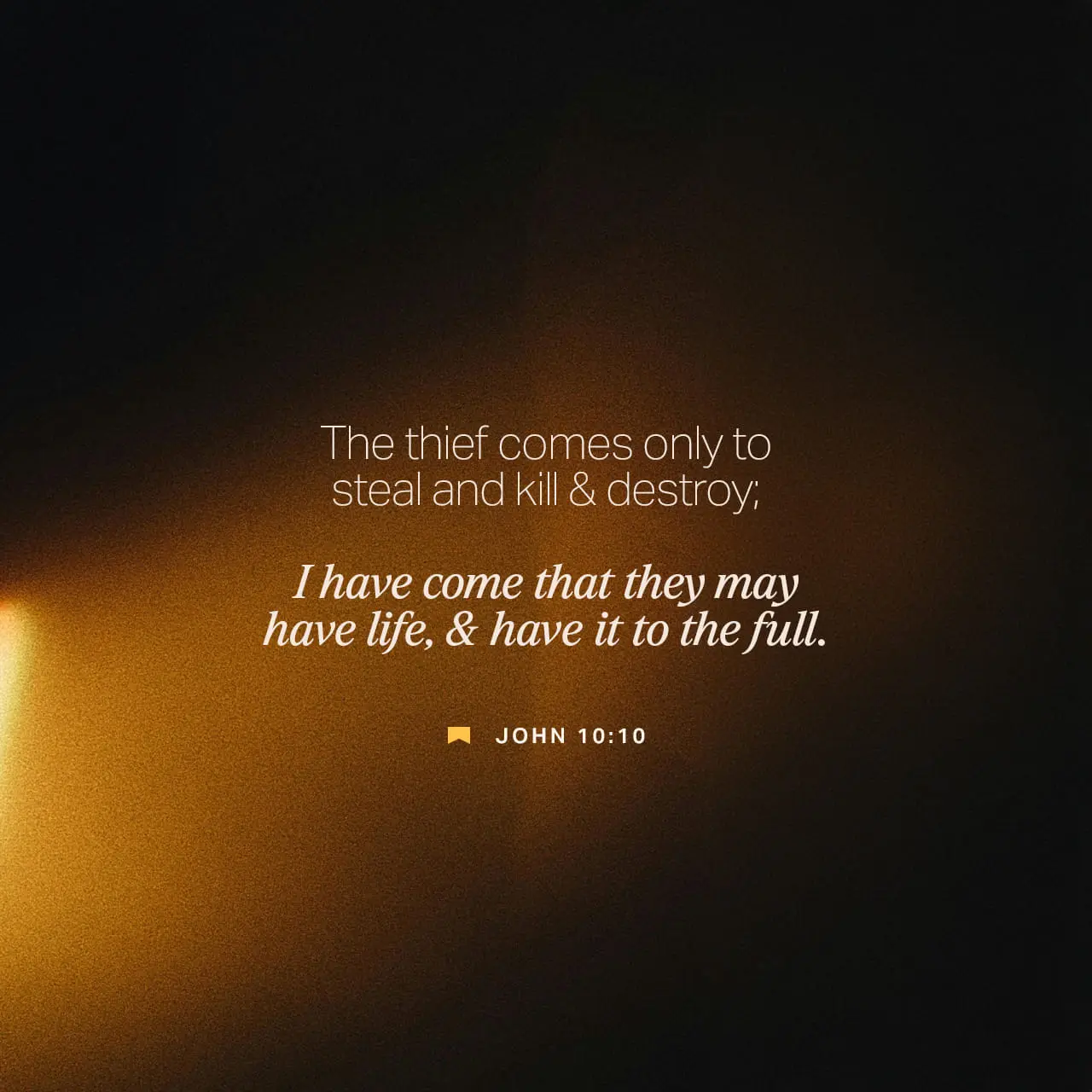
In John 10:10, Jesus gives us a glimpse into one of the core reasons He came to us, contrasted sharply against Satan’s reason for being:

Borrowed from YouVersion

This verse is powerful and hopeful, yet many people fail to grasp its significance. Instead of embracing the fullness of life that Jesus offers, they settle for lesser things—temporary pleasures, material possessions, or even destructive habits. They allow the evil one to steal, kill, and destroy the richness of their lives. Why is that?

The Apostle Paul gives us insight into this in Romans 1:25, where he writes:

“They exchanged the truth about God for a lie, and worshiped and served created things rather than the Creator—who is forever praised. Amen.”

Paul the Apostle, in Romans 1:25 (NIV)

This exchange is at the heart of why so many people miss out on the abundant life Jesus offers. They’ve replaced the eternal with the temporal, the Creator with the created, and in doing so, they’ve forfeited the fullness of life that God intends for them.

What It Means to Live Life to the Full

So, what does it mean to live life to the full? Is it about accumulating wealth, achieving success, or fulfilling all our desires? While these things might bring temporary satisfaction, they are not the fullness that Jesus speaks of. Living life to the full is about much more than our circumstances or possessions; it’s about the deep, abiding presence of God in our lives, the joy of knowing Him, and the peace that comes from being aligned with His purposes.

  1. Abiding in Christ

In John 15:5, Jesus says, “I am the vine; you are the branches. If you remain in me and I in you, you will bear much fruit; apart from me you can do nothing.” Living life to the full begins with abiding in Christ. It means staying connected to Him, drawing our strength, wisdom, and purpose from Him. It also means honestly confessing our sins to Him, when (not if) we screw up, trusting Him to forgive us–which He has already done–and not kick us to the curb. This allows us not to drag all that guilt-baggage around with us. Just as branches cannot bear fruit without being attached to the vine, we cannot experience the fullness of life without being in constant relationship with Jesus.

  1. Experiencing True Peace

Jesus also promises us peace—not as the world gives, but a peace that surpasses understanding. In John 14:27, He says, “Peace I leave with you; my peace I give you. I do not give to you as the world gives. Do not let your hearts be troubled and do not be afraid.” This peace is not dependent on external circumstances but on our internal connection with God. It’s the kind of peace that allows us to remain calm in the midst of life’s storms because we know that our foundation is secure in Christ.
  1. Living with Purpose

In Ephesians 2:10, Paul writes, “For we are God’s handiwork, created in Christ Jesus to do good works, which God prepared in advance for us to do.” Part of living life to the full is understanding and fulfilling the purpose for which God created us. When we align our lives with His will and engage in the good works He has prepared for us, we find a deep sense of fulfillment and joy that nothing else can provide.

  1. Cultivating Joy

The joy that Jesus offers is another aspect of a full life. In John 15:11, Jesus says, “I have told you this so that my joy may be in you and that your joy may be complete.” True joy comes from knowing Christ and being in relationship with Him. It’s a joy that is not shaken by life’s difficulties because it is rooted in the unchanging nature of God.

  1. Eternal Perspective

Living life to the full also means living with an eternal perspective. In Colossians 3:2, Paul instructs us, “Set your minds on things above, not on earthly things.” When we focus on eternity and the promises of God, we are less swayed by the temporary troubles and attractions of this world. We understand that our true life, the fullness of life, is found in our relationship with God and the eternal life He offers.

What Does Life to the Full Look Like?

When you picture someone living life to the full, do you think of someone with a dour look on their face? Do you picture someone dressed a certain way or with a particular haircut? How about someone stewing about judgment—either their own by God or (worse) their judgment of others? I don’t think that’s what Jesus meant by living life to the full, do you?

Living life to the full means embracing the freedom that Jesus offers us. It’s a life marked by joy, not sorrow; by peace, not anxiety; by love, not judgment. Imagine a person whose life is filled with purpose and meaning, who wakes up each day with a sense of excitement and anticipation for what God has in store. This person is not weighed down by the cares of this world but is free to love, to serve, and to experience the beauty of God’s creation.

Life to the full is characterized by a deep, abiding joy that is not dependent on circumstances. It’s the kind of life where you can dance in the rain, laugh in the face of adversity, and find beauty in the simplest things. It’s a life of gratitude, where every day is seen as a gift from God, and every breath is an opportunity to praise Him.

This fullness of life is not about perfection or having it all together. It’s about being fully alive in Christ, embracing both the highs and lows of life with the assurance that God is with you every step of the way. It’s about knowing that you are loved unconditionally by your Creator and that nothing in this world can separate you from His love (Romans 8:38-39).

Conclusion

Jesus came so that we might have life and have it to the full. This fullness is not about worldly success or temporary pleasures; it’s about abiding in Christ, experiencing His peace, living with purpose, cultivating joy, and maintaining an eternal perspective. Unfortunately, many people miss out on this because they’ve exchanged the truth of God for a lie, misunderstanding what life in relationship with God is supposed to look like. They’ve made up their own sort of god, and worship that cheap imitation (whether or not they realize it) instead of the True Creator.

But it’s never too late to turn back to the Source of True Life. Jesus invites us to come to Him, to lay down our burdens, and to experience the abundant life He offers. As we draw closer to Him, we begin to understand that the fullness of life is found not in what we have, but in who we know—Jesus Christ, our Lord and Savior.

I hope you will join me in striving every day to embrace the full life that Jesus offers, living each day in the joy, peace, and purpose that come from knowing Him.

Posted in Biblical insights, Biblical Teachings, Christian, Christian Living, Christianity and Mental Health, Daily Devotional, Faith, Faith and Encouragement, Faith and Inspiration, God's love, Inspirational, Jesus and the Gospel, Jesus's teachings, Self-Improvement, Spiritual Encouragement, Spiritual Growth, Spiritual Reflection | Tagged , , , , , , , , , | Leave a comment

Weary and Burdened

Introduction

I’m feeling a bit weary and burdened today. How about you?

To be clear, it’s not necessarily only because of bad things that I feel a little worn out. We’re enjoying an active lifestyle, including activities I enjoy, such as pickleball, hiking, and kayaking. But there are never enough hours in the day to fit in responsibilities like keeping up on the work in my yard. I live in Florida now, where weeds grow faster than the national debt, and the weeds in a couple of my gardens were forming a committee to figure out how to take over the house. Weedless to say (sorry, that pun seems awfully funny to me right now, in my tired state), I had to attend to that situation.

Burdened? Well, that’s a different story. Not as much fun is involved in making me feel that way, of course. Nothing that many other people aren’t undoubtedly experiencing, though–challenges in my kids’ lives that I wish I could fix, and job-related stresses.

What am I to do about all of that?

The Invitation

There’s Jesus. He’s speaking to a crowd, but He looks directly into my eyes (OK, and yours, too) as He says:

“Come to me, all you who are weary and burdened, and I will give you rest.”

Jesus, in Matthew 11:28 (NIV)

This simple yet powerful statement captures the essence of what Jesus desires for me, for you. But what exactly did He mean by this? Let’s take a deeper look at His words and explore the comfort and hope they bring.

An Invitation to True Rest

When Jesus invites us to come to Him, He is not merely offering a break from our busy schedules or a temporary respite from stress. He is offering something far more profound—a deep, soul-restoring peace that can only come from Him. This rest is not just physical but spiritual. It’s the kind of rest that heals our inner wounds, calms our anxious minds, and renews our weary spirits.

No Judgment, Only Compassion

One of the most beautiful aspects of this invitation is that Jesus calls us to Him not to judge us or condemn us for our past mistakes or failures. He doesn’t ask us to get our lives together or look a certain way before we come to Him. Instead, He meets us where we are, in the middle of our messes, and offers us His grace and compassion. In John 3:17, He reminds us of His mission:

“For God did not send his Son into the world to condemn the world, but to save the world through him.”

Jesus, in John 3:17 (NIV)

Jesus wants to lift the burdens that weigh us down, not to add to them. He doesn’t demand anything in return. He doesn’t tell us to get a haircut or dress better or clean up our act in any way. He doesn’t even tell us we have to go to church (although once you are in relationship with Him, I think you will want to go to church to praise Him in fellowship with other believers and to be reminded how spectacularly helpful it is to have Him in your corner!).

His heart is full of love and understanding–remember that He led a difficult life while He walked this earth, so He understands our pain, our weariness, our burdens. He stands by, ready to embrace us no matter how far we’ve strayed or how deep our pain runs. He’s there, ready to help us carry all the baggage and garbage with which we have weighed ourselves down.

The Fiery Furnace: The God Who Walks with Us

A powerful example of God’s presence and deliverance is found in the book of Daniel. When Shadrach, Meshach, and Abednego refused to worship the golden statue that King Nebuchadnezzar had set up, they were thrown into a fiery furnace. Yet, amid the flames, they were not alone. King Nebuchadnezzar himself was astonished to see not three, but four men walking unharmed in the fire:

“He said, ‘Look! I see four men walking around in the fire, unbound and unharmed, and the fourth looks like a son of the gods.'”

Daniel 3:25 (NIV)

This fourth figure, whom many believe to be a pre-incarnate appearance of Jesus, was with them in the fire, protecting them from harm. Instead of lamenting their situation, Shadrach, Meshach, and Abednego praised God for His presence and deliverance. Their story is a powerful reminder that when we are in the midst of our own fiery trials, Jesus is with us, helping us endure and ultimately leading us to victory.

The pastor at church this morning pointed out something about this story I had never considered before: the story goes on to say that Shadrach, Meshach, and Abednego came out of the fire unharmed. But it fails to mention that Jesus came out of the fire.

Why would that be? Maybe because He is still in the fire, waiting for us to need His help!

God’s Desire to Rescue and Restore

Throughout the Bible, we see countless examples of God’s desire to rescue His people. In Psalm 34:17-18, for instance, we are reminded of God’s readiness to deliver those who turn to Him:

“The righteous cry out, and the Lord hears them; he delivers them from all their troubles. The Lord is close to the brokenhearted and saves those who are crushed in spirit.”

Psalm 34:17-18 (NIV)

God’s heart is always inclined toward rescue and restoration, not judgment. He seeks to draw us close, to comfort us in our distress, and to lift us out of our despair. This is further emphasized in Isaiah 41:10, where God promises His presence and help:

“So do not fear, for I am with you; do not be dismayed, for I am your God. I will strengthen you and help you; I will uphold you with my righteous right hand.”

Isaiah 41:10 (NIV)

Conclusion: Embrace the Invitation

Jesus’ invitation to “Come to me” is open to all who are weary and burdened, offering a refuge from the storms of life. He doesn’t require us to have it all together or to be free from struggles before we approach Him. Instead, He invites us to bring our burdens, our fears, our failures, and our doubts to Him, knowing that in His presence, we will find the rest and restoration we so desperately need.

As we face our own challenges and fiery trials, let us remember that Jesus is with us, walking beside us, offering His strength, peace, and love. Let us take comfort in His promise that He will give us rest—not just for our bodies, but for our souls. And as we experience His rest, may we find the courage to praise Him even in the midst of the fire, knowing that He is our ever-present help in times of trouble.

Posted in Biblical insights, Biblical Teachings, Christian, Christian Living, Christianity and Mental Health, Daily Devotional, Dependence on God, Faith, Faith and Encouragement, God's love, Inspirational, Jesus's teachings, Life Challenges, Miracles, Spiritual Encouragement, Spiritual Growth, Spiritual Reflection, Trust in God | Tagged , , , , , , , , , , , , , , , , , | Leave a comment

Build Your House on the Rock

Introduction

This week has been particularly challenging for my younger daughter. She is going through an extremely difficult situation in her life right now. As her dad, it hurts me deeply to see her suffering. I wish I could take away her pain and bear it myself. Unfortunately, I can’t. All I can do is be there for her, offering support and comfort from afar (for now) since I moved to Florida and she is still in Colorado.

This situation with my daughter has made me reflect on our Heavenly Father’s love and care for us. Just as I long to alleviate my daughter’s pain, God desires to comfort and heal us in our suffering. He has gone to the greatest lengths to demonstrate His love, even to the point of sacrificing His own Son to take away our pain—the pain of eternal separation from Him.

I believe He also wants to alleviate the “everyday” pain that can ruin our days, months or years, but He also gave us free will. Sometimes the choices we make–or others around us make–can be the cause of our pain, and He generally seems to avoid intervening in many of those situations. Having said that, though, it can be difficult for us to discern whether or when God intervenes, since His ways are often beyond our comprehension (“For my thoughts are not your thoughts, neither are your ways my ways,” declares the Lord. “As the heavens are higher than the earth, so are my ways higher than your ways and my thoughts than your thoughts.” Isaiah 55:8-9 (NIV)).

However, since I am aware of God’s sacrificial love for me and all of us, I’m confident that He would like very much for us to stop making decisions that destroy our own lives or the lives of others.

God’s Sacrificial Love

In John 3:16, we read about the magnitude of God’s love for us:

“For God so loved the world that he gave his one and only Son, that whoever believes in him shall not perish but have eternal life.”

John 3:16 (NIV)

Through Jesus’ sacrificial death on the cross, God has taken away the ultimate pain of eternal torment in hell. This act of love and redemption is the foundation upon which we can build our lives. It’s a foundation that can withstand any storm life throws at us.

Building on the Rock

Jesus emphasized the importance of building our lives on a firm foundation as part of His Sermon on the Mount:

“Therefore everyone who hears these words of mine and puts them into practice is like a wise man who built his house on the rock. The rain came down, the streams rose, and the winds blew and beat against that house; yet it did not fall, because it had its foundation on the rock. But everyone who hears these words of mine and does not put them into practice is like a foolish man who built his house on sand. The rain came down, the streams rose, and the winds blew and beat against that house, and it fell with a great crash.”

Matthew 7:24-27 (NIV)

Jesus is the rock on which we should build our lives. We will face storms in this life—He told us so in John 16:33:

These verses remind us that while trouble is inevitable, having Jesus as our foundation ensures that our life-houses will stand firm, regardless of the storm’s severity.

My Prayers for My Daughter

As my daughter navigates this difficult period, one of my prayers for her is that she will recognize the strength and stability that comes from building her life on Jesus. I pray that she will learn to lean on Him and not on the transient things of this world.

The House of My Life

Reflecting on my life, I can attest to the importance of building the house of my life on the foundation of Jesus. I have endured some very difficult challenges throughout my life. Early on, before God helped me develop a strong faith, when bad things happened to me, I felt like I had no hope and no future. But the more I deepen my faith and my relationship with God, the more I can focus on the eternal prize and allow the storms of this life to impact me less and less.

Paul the Apostle writes about this eternal perspective in 2 Corinthians 4:17-18:

“For our light and momentary troubles are achieving for us an eternal glory that far outweighs them all. So we fix our eyes not on what is seen, but on what is unseen, since what is seen is temporary, but what is unseen is eternal.”

2 Corinthians 4:17-18 (NIV)

These verses have been a source of strength for me, helping me to endure life’s challenges by keeping my eyes fixed on what comes next instead of what may be ruining my day, month, or year.

Conclusion

So, I think we can all agree that we will face storms in this life. It’s not a matter of if, but when. However, the foundation upon which we choose to build our lives will determine how we withstand these storms. Jesus, the true and original Rock, offers us a firm and unshakable foundation. By building our lives on Him, we can endure the storms and emerge stronger.

Let’s all become more and more like the wise man who built his house on the rock. No matter what life throws at us, we can have confidence and peace knowing that our foundation is secure in Christ.

Posted in Biblical insights, Biblical Teachings, Christian, Christian Living, Faith, Faith and Encouragement, Life Challenges, Spiritual Encouragement, Spiritual Growth, Spiritual Reflection | Tagged , , , , , , , , , , , | Leave a comment

Holding On to Hope: How God’s Promise Can Anchor Us Through Mental Health Challenges

Introduction

In today’s world, where uncertainties and challenges are ever-present, hope is more crucial than ever. Many people place their hope in various sources—relationships, careers, political leaders—only to find that these often fail to deliver lasting security and peace. This misplaced hope can lead to a sense of hopelessness, which is a breeding ground for numerous mental health challenges. In contrast, Jesus offers a steadfast source of hope that can anchor us through life’s storms.

The Hope Described in Romans 4

In his letter to the Roman church, the Apostle Paul speaks about the hope that comes from faith in God’s promises. Paul reflects on the story of Abraham, who, despite his advanced age and the barrenness of Sarah’s womb, believed in God’s promise that he would become the father of many nations. Here’s what Paul says:

Against all hope, Abraham in hope believed and so became the father of many nations, just as it had been said to him, ‘So shall your offspring be.’ Without weakening in his faith, he faced the fact that his body was as good as dead—since he was about a hundred years old—and that Sarah’s womb was also dead. Yet he did not waver through unbelief regarding the promise of God, but was strengthened in his faith and gave glory to God, being fully persuaded that God had power to do what he had promised.”

Romans 4:18-21 (NIV)

The Impact of Hopelessness on Mental Health

When people lose hope–or build their hope on earthly foundations–they can face a range of mental health issues. Hopelessness can lead to:

  1. Depression: Feelings of deep sadness and despair often stem from a belief that there is no hope for improvement and that the future looks bleak.
  2. Anxiety: Constant worry about the future can be exacerbated by a lack of hope.
  3. Substance Abuse: Some individuals turn to drugs or alcohol or other addictions to numb the pain associated with hopelessness.
  4. Chronic Stress: Hopelessness can result in prolonged stress, affecting both mental and physical health.
  5. Suicidal Thoughts: A profound sense of hopelessness can lead some to believe that life is not worth living.

Misplaced Hope and Its Consequences

Placing hope in things that are inherently unstable—like other people, careers, or political ideologies—can be disastrous. While relationships and careers are important, they are not infallible and can change or fail us. Misplaced hope can lead to disillusionment and a deeper sense of despair when these sources fail to provide the security and fulfillment we seek.

Anchoring Our Hope in God

In contrast, anchoring our hope in God provides a firm foundation. Like Abraham, we are called to trust in God’s promises, even when circumstances seem dire. Paul’s words in Romans 4 remind us that true hope is not based on our situation but on God’s unchanging character and promises.

The author of the book of Hebrews beautifully describes this hope as an anchor for our souls:

“We have this hope as an anchor for the soul, firm and secure.”

Hebrews 6:19 (NIV)

This verse vividly captures the stabilizing power of hope in God, likening it to an anchor that keeps a ship steady amidst turbulent waters. It reassures us that hope in God is never misplaced; it does not lead to disappointment but instead grounds us in God’s steadfast love and faithfulness.

How God’s Hope Helps Us Navigate Mental Health Challenges

  1. Provides Perspective: Knowing that God has a plan for us, that He works for our good, and that His promises are certain can help us see beyond our current struggles.
  2. Strengthens Faith: Just as Abraham’s faith was strengthened, our faith grows as we hold onto God’s promises, helping us face challenges with resilience.
  3. Offers Peace: God’s hope brings a peace that transcends understanding, helping to calm our anxious minds (Philippians 4:7).
  4. Encourages Community: Faith in God often leads us to a supportive faith community, which can provide additional support and encouragement.

Conclusion: Choosing the Right Foundation for Hope

In our journey through life, the foundation of our hope significantly impacts our mental health and overall well-being. By choosing to anchor our hope in God, we align ourselves with a source that is eternal, unchanging, and steadfast. This hope does not disappoint but strengthens and sustains us through all of life’s challenges.

Each of us should try each day to re-commit to placing our hope in God. In doing so, we can find the strength to face each day with renewed faith and confidence, knowing that God’s promises are true and His love for us is unwavering.

Posted in Biblical insights, Biblical Teachings, Christian, Christian Living, Christianity and Mental Health, Daily Devotional, Dependence on God, Faith, Faith and Dependence, Faith and Encouragement, God's love, Mental Health and Wellness, Self-Improvement, Spiritual Encouragement, Spiritual Reflection | Tagged , , , , , , , , , , , , , , , | Leave a comment

Dependence on God: Lessons from My Grandsons

Introduction

This past week, I had the incredible joy and blessing of welcoming my second grandson into the world while continuing to spend time with my 2-year-old grandson. Observing the stark contrast between the complete helplessness of a newborn and the growing, yet still limited, independence of a toddler has offered me profound insights into our own relationship with God.

The Helplessness of a Newborn

My newborn grandson is utterly dependent on his parents for everything. He needs them for nourishment, comfort, warmth, and protection. He can’t do anything on his own. He can’t even hold up his head or focus his eyes. His vulnerability is a poignant reminder of the initial stage of life where survival is entirely dependent on the care and provision of others.

Nothing to Deserve This Love and Protection

It’s also worth noting that this newborn has done nothing to deserve or earn the love and protection his parents give him. But they give it to him anyway, because they love him. Does that sound familiar?

The Small Steps of Independence

Anyway, back to the narrative about both my grandsons. In contrast to the newborn, my 2-year-old grandson is starting to explore the world with a bit of independence. He can walk, communicate his basic needs, and even play on his own and with his doggy friends for short periods. Yet, despite these small steps toward autonomy, he remains profoundly dependent on his parents. He needs their guidance, support, and care. He can’t yet navigate life’s complexities or dangers on his own.

Our Illusion of Independence

As adults, we often pride ourselves on our independence. We like to think we’ve got it all under control. We’re the Marlboro Man or Wonder Woman—self-sufficient and ruggedly independent. This cultural ideal can lead us to believe that we only need God in times of crisis, when things get really bad. However, the truth is far from this illusion. We are more like my infant grandson, or at best, my 2-year-old grandson, in our dependence on God. We wouldn’t last a day without Him.

Biblical Perspective on Dependence

The Bible reminds us of our need to approach God with the humility and dependence of a child. Jesus Himself emphasized this when He said:

“Truly I tell you, unless you change and become like little children, you will never enter the kingdom of heaven.”

Matthew 18:3 (NIV)

This verse highlights the importance of recognizing our dependence on God. Like children, we are to trust in His provision, guidance, and care, acknowledging that we cannot navigate life’s complexities on our own.

Every Breath a Gift

We don’t think of it every time we breathe, but our very existence is sustained by God. Each breath we take is a gift from Him, as Luke, the author of the Book of Acts points out:

“For in him we live and move and have our being.”

Acts 17:28 (NIV)

This verse reminds us that our lives are intricately connected to God. Without His sustaining power, we wouldn’t be able to draw our next breath, let alone handle the challenges and responsibilities of life.

Embracing Our Dependence

Recognizing our dependence on God is not a sign of weakness but an acknowledgment of reality. It is in this acknowledgment that we find true strength and peace. When we rely on God, we tap into His infinite wisdom, strength, power, and love. Paul the Apostle encourages us with these words:

“I can do all this through him who gives me strength.”

Philippians 4:13 (NIV)

This verse reassures us that with God’s help, we can face any situation, no matter how daunting it may seem.

Conclusion: Living in Dependence

As I reflect on the growth and dependence of my grandsons, I am reminded of our own need for God. We may achieve small steps of independence in our lives, but in reality, we are wholly dependent on our Creator. Let us embrace this dependence, not as a limitation, but as a source of strength and peace. After all, as Paul reminds us:

May we, like children, trust in God’s provision, guidance, and care. Let us remember that every breath we take is a gift from Him and that we can do all things through Him who gives us strength. In acknowledging our dependence on God, we find the true freedom to live fully and confidently in His grace and love.

Posted in Biblical insights, Biblical Teachings, Christian, Christian Living, Daily Devotional, Dependence on God, Faith, Faith and Dependence, Faith and Encouragement, Family Relationships, God's love, Jesus's teachings, Mental Health and Wellness, Spiritual Encouragement, Spiritual Growth, Spiritual Reflection, Trust in God | Tagged , , , , , , , , , , , , , , | Leave a comment

What It Means To Be Etched into the Palms of God’s Hands

Introduction

In today’s “always connected” world, ironically, we seem to be drifting farther and farther away from one another, and sometimes even from God. There are moments when it’s easy to feel isolated, forgotten, or insignificant. Yet, in those very moments, Scripture offers us profound assurances of God’s unwavering love and constant presence. One such assurance is found in Isaiah 49:16, where God declares His enduring commitment to His people with a powerful image:

“I have engraved you on the palms of my hands.”

Isaiah 49:16 (NIV)

The Permanence of Being Engraved

The imagery here is powerful and deeply comforting. To be engraved is to be permanently marked. Have you ever written an important phone number on you hand, then washed your hands, forgetting it was there? That’s not going to happen here. Engraving our names means they can’t be washed away or easily removed. This speaks to the permanence of God’s commitment to us. Unlike a temporary mark that fades with time, engraving lasts. It signifies that our relationship with God is enduring and unbreakable.

A Love Beyond Compare

In the same passage of scripture, God also paints another picture to show us how much He loves us:

“Can a mother forget the baby at her breast and have no compassion on the child she has borne? Though she may forget, I will not forget you!”

Isaiah 49:15 (NIV)

In these words, God compares His love for us to a mother’s love for her child, probably one of the strongest forms of human affection. Even in the rare instance that a mother might forget her nursing child, God assures us that He will never forget us. His love is even more profound, more reliable, and more enduring.

Constant Remembrance and Care

The palms of the hands are one of the most visible and sensitive parts of the body. By saying that we are engraved on His palms, God is telling us that we are always before Him. Every time He “looks at His hands,” He sees us. This indicates a continuous, intimate awareness and care for our well-being. We are never out of His sight or mind. In our moments of doubt or despair, when we feel alone or forgotten, we can hold onto this truth: we are constantly remembered and cared for by our Creator.

A Symbol of Sacrifice and Love

For followers of Christ, this imagery takes on even deeper significance when we consider the account of Jesus’ crucifixion. His hands were pierced by nails as He was crucified—a supreme act of love and sacrifice. This act forever marked His hands–etching our names on the palms of His hands–symbolizing the depth of His love and the lengths He would go to redeem us. There is no greater love than this.

Ever Before Him

The verse continues, “your walls are ever before me” (Isaiah 49:16, NIV). In the context of Isaiah, this likely referred to the walls of Jerusalem, representing the city and its people. For us, it means that God is always mindful of our circumstances and needs. He is aware of our struggles, our hopes, and our prayers. He knows when we feel forgotten, alone, insignificant. He longs for us to remember that His watchful eye and caring heart are always upon us.

Finding Comfort in God’s Assurance

Understanding what it means to be engraved on the palms of God’s should give us great comfort. It reassures us that we are never forgotten or abandoned. God’s love for us is steadfast and eternal. When we feel overwhelmed by life’s challenges or when our prayers seem unanswered, we can remember this powerful image. We are permanently etched into His hands, held close, and cherished deeply.

Conclusion: Embrace the Assurance of God’s Love

As we reflect on the significance of being engraved on the palms of God’s hands, let it fill us with peace and confidence. Our value and worth are not determined by our circumstances or how others perceive us, by our jobs or the size of our bank accounts, but by God’s everlasting love. We are cherished, remembered, and protected by the One who created the heavens and the earth.

In times of uncertainty, let this truth anchor our hearts. Let it remind us that we are always in God’s thoughts and under His care. His love for us is permanent, intimate, and sacrificial. As we go about our daily lives, may we hold onto this assurance, finding strength and comfort in the knowledge that we are etched into the very palms of God’s hands.

Posted in Biblical insights, Biblical Teachings, Christian, Christian Living, Christianity and Mental Health, Daily Devotional, Faith, Faith and Encouragement, God's love, Jesus's teachings, Mental Health and Wellness, Spiritual Encouragement, Spiritual Growth, Spiritual Reflection, Trust in God | Tagged , , , , , , , , , , , , , , | Leave a comment

Ask for Help

Introduction

Spending time with my 2-year-old grandson (and his mommy and daddy) has been one of the greatest joys of my life. Watching him grow and learn is a privilege, and it constantly reminds me of life’s simplest yet deepest lessons. Lately, we’ve been teaching him a crucial skill: asking for help. When he gets frustrated, he often squeals and screeches, not knowing how to express his need for assistance. Our goal is to teach him to use his words and ask for help when needed.

The Challenge of Asking for Help

This got me thinking about how, as adults—especially men—we often struggle with asking for help. We might not squeal and screech like a toddler, but our frustration can manifest in other, often unhealthy, ways. We might lash out in anger, withdraw into silence, or turn to harmful habits to cope. It’s a universal challenge: the fear of appearing weak or incompetent keeps us from reaching out when we need it most.

Finding the Courage to Ask

Just as my grandson is learning to ask for help, we too must cultivate the courage to do the same. Life’s challenges are too great to face alone, and we were never meant to bear our burdens in isolation. The Bible reminds us of the importance of community and the strength that comes from shared struggles. In the Old Testament, King Solomon reminds us:

Two are better than one, because they have a good return for their labor: If either of them falls down, one can help the other up. But pity anyone who falls and has no one to help them up.

Ecclesiastes 4:9 (NIV)

Building a Support System

We all need people in our lives we can turn to for support. If you don’t have such people, it’s crucial to make an effort to find them and cultivate those relationships. Join a community based around similar interests or hobbies (i.e., Bible study group, hiking club, etc.), make new friends, or seek out a support group. Sometimes, professional help from a counselor or therapist is necessary and incredibly beneficial. Asking for help is not a sign of weakness; it’s a sign of wisdom and strength.

Reaching Out to God

In addition to seeking help from those around us, we should continually reach out to God. Jesus encourages us to do this:

“Ask and it will be given to you; seek and you will find; knock and the door will be opened to you. For everyone who asks receives; the one who seeks finds; and to the one who knocks, the door will be opened.”

Jesus, in Matthew 7:7-8 (NIV)

Jesus invites us to ask, seek, and knock—to actively reach out to God for help.

Further, the Apostle Paul reminds us in 1 Thessalonians 5:17 to “pray continually.” This means maintaining an ongoing conversation with God throughout our day, bringing our needs, frustrations, and thanks to Him. God is always available, always listening, and always ready to provide the help we need. All we need to do is ask Him.

Embracing the Power of Prayer

Prayer is a powerful tool, not just for asking for what we need but for aligning our hearts with God’s will and finding peace in His presence. When we pray, we acknowledge our dependence on God and open ourselves up to His guidance and strength. Paul encourages us:

“Do not be anxious about anything, but in every situation, by prayer and petition, with thanksgiving, present your requests to God. And the peace of God, which transcends all understanding, will guard your hearts and your minds in Christ Jesus.”

Philippians 4:6-7 (NIV)

Conclusion: A Call to Ask

As we teach my grandson to ask for help, I’ll benefit from remembering to apply this lesson to my own life. I’ll bet the same is true for you. Whether we need support from friends, family, or professionals, or we need divine assistance through prayer, asking for help is a crucial step towards a healthier, more fulfilling life.

Let’s embrace the wisdom in seeking help, knowing that it brings us closer to each other and to God. May we find the courage to ask, the humility to receive, and the grace to support others in their times of need. And in doing so, may we all experience the strength and peace that comes from being part of a loving, supportive community, and from being held in the strong arms of our loving Father.

Posted in Biblical insights, Biblical Teachings, Christian, Christian Living, Christianity and Mental Health, Daily Devotional, Faith, Family Relationships, Jesus's teachings, Mental Health and Wellness, Prayer and faith, Prayer and Worship, Self-Improvement, Spiritual Encouragement, Spiritual Growth, Spiritual Reflection, Trust in God | Tagged , , , , , , , , , , , , , , | 2 Comments