Oops, I Did It Again

I should start by pointing out that this blog post has nothing to do with the Britney Spears song by the same title, so if you landed here looking for insight into her lyrics (or anything else about the song), you might be lost. Having said that, though, maybe you didn’t end up here by accident after all, so feel free to stick around.

What I wanted to talk about instead is my tendency to screw things up. And your tendency to do the same. Well, and everybody’s tendency to do things we wish we wouldn’t do.

If that makes you feel bad, you should know that when the Holy Spirit inspired various people to write the gospels, letters, and historic accounts that eventually became the Bible, He anticipated that we would all be challenged by the temptation to sin. How do I know this? Because there are passages that are not very flattering for some famous leaders of the Christian church.
Peter and Paul

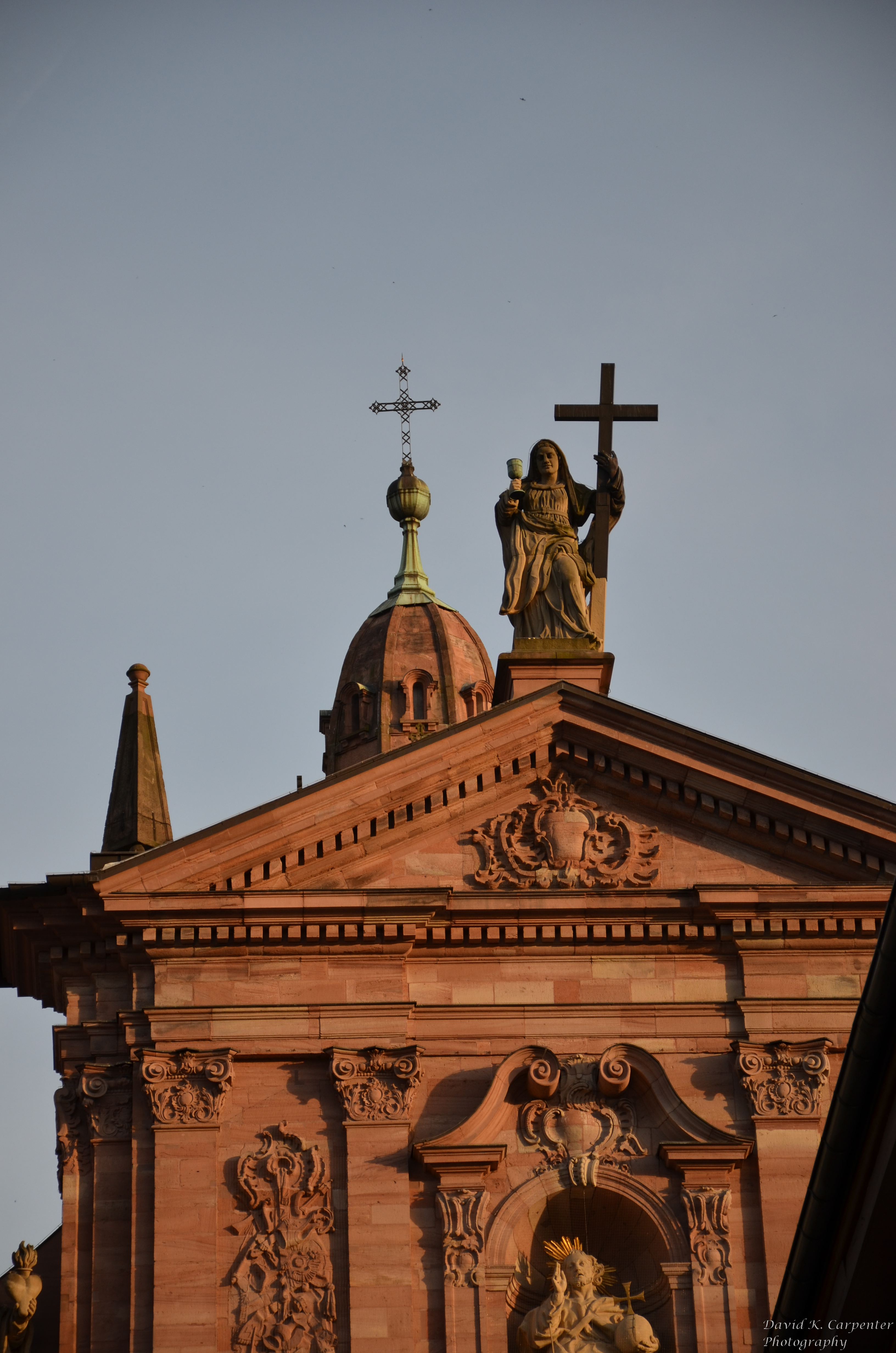
My first example is Peter. Jesus told Peter that He was going to build His church upon that rock (most likely a play on the name Jesus gave him–“Petros” is greek for rock). Of course, that’s the way it turned out, but it wasn’t a smooth road to get there. Before Peter became a great leader in the early church, He lied to Jesus. Or at the very least, he was disingenuous and failed to live up to his commitment to Jesus.

As Jesus was preparing Himself for His coming crucifixion, He shared His Last Supper with His disciples. Then they went out to the Mount of Olives, where Peter made his bold promise to his Saviour:

Peter declared, “Even if all fall away, I will not.”
“Truly I tell you,”Jesus answered, “today—yes, tonight—before the rooster crows twice, you yourself will disown me three times.”
But Peter insisted emphatically, “Even if I have to die with you, I will never disown you.” And all the others said the same.

Mark 14:29-31 (NIV, emphasis added)

Actually, it’s really two promises, since he restated it more emphatically. The great Apostle Peter committed to Jesus that he would never turn his back on his friend. But we know he did just as Jesus had predicted (see Mark 14:66-72).

Also, there’s Paul. He wrote about half the books in the New Testament. And yet, he admits in his letter to the church in Rome that he screwed up regularly:

I do not understand what I do. For what I want to do I do not do, but what I hate I do. And if I do what I do not want to do, I agree that the law is good. As it is, it is no longer I myself who do it, but it is sin living in me. For I know that good itself does not dwell in me, that is, in my sinful nature. For I have the desire to do what is good, but I cannot carry it out. For I do not do the good I want to do, but the evil I do not want to do—this I keep on doing. 

Romans 7:15-19 (NIV)

Of course, he wrote it in as obscure a way as possible (even for Paul), maybe hoping that nobody could sort out exactly what he was saying…?

What’s it All about, if not Grace?

So, what’s the point of reminding us all how rotten we are? Well, for one thing, we are rotten by nature, whether we realize it or not. But that’s OK, since it is only by God’s grace that we are saved–not because we are particularly swell people. What do we have to do to earn that grace? We can’t, really, or else it wouldn’t be grace! It would be something we’ve done so God has to save us from ourselves.

But that’s not God’s way. His was was to send His Son to save us and show us the path to heaven: believe in Him. And although “believe” is an action verb (perhaps tempting one to think, Aha, there is something I can do to earn my salvation!), in reality, belief is more about your posture of heart than it is about something you can force yourself to do.

Here’s how Paul embraced the beatiful exchange of belief and grace:

By entering through faith into what God has always wanted to do for us—set us right with him, make us fit for him—we have it all together with God because of our Master Jesus. And that’s not all: We throw open our doors to God and discover at the same moment that he has already thrown open his door to us. We find ourselves standing where we always hoped we might stand—out in the wide open spaces of God’s grace and glory, standing tall and shouting our praise.

Romans 5:1-4 (MSG)

This is the passage where Paul famously says “Lord Jesus Christ, through whom we have gained access by faith into this grace in which we now stand”, but I really like Eugene Peterson’s expansive view of this in “The Message” paraphrase.

Photo by Julentto Photography on Unsplash

So, how is it that the perfect and holy God accepts us in spite all our blemishes, regardless of all the awful things we have done and will ever do?

Grace.

It’s the gift offered freely to all of humanity, for those with eyes to see, ears to hear, and softened heart to receive.

Fundamental Attribution Error

One last point about this. There’s a term in social pshychology referred to as the “fundamental attribution error”. Although I may not be 100% correct about this (I’m not a shrink, just an avid reader), my interpretation of this is that when we judge other people’s behavior, we judge them mostly by their actions; however, when we think of our own actions, we judge them by our intentions.

This is probably why I have uttered the phrase, “I didn’t mean to hurt you” more times than I can probably count. And I’m guess you have, too. I justify what I did by my (hopefully) loving intentions. However, if I saw someone else do the same thing, I’d likely think something like, What a turd, that wasn’t very nice. (We’ll talk about judgment another time–I know we shouldn’t do it, but that is a long, hard lesson to learn in our western civilization).

So, what’s the point?

Well, of course, when we screw up, we should ask for and receive God’s forgiveness. If what we have done something that has hurt someone else (regardless of your intent), we should ask for and receive God’s forgiveness (it probably also a sin against Him) and we should apologize and seek forgiveness of the person we’ve harmed.

And…

You mean there’s more??

Yes. And, we should go easy on other people, even when they are behaving badly. Maybe especially when they are behaving badly (I’m not talking about when lives are in imminent danger, that’s a different story). Instead of a knee-jerk negative reaction ramping up to a fight, we should try to think about why that person might be behaving badly. Try to consider what might make you act in that way. Maybe they feel like they have no other option. Or maybe they don’t think they are behaving badly.

Either way, our reaction, and the words that may come out of our mouths, might be more uplifting for that person than if we react without pausing to reflect on what might have led them to this behavior (and maybe even saying a quick prayer for them and for you that you respond well). This is the way Jesus interacted with people (except for “holier than thou” religious leaders). You just never know the impact you might have on that person. If you react gently (but firmly is still OK), you might diffuse a very tense situation. You might reflect a little bit of God’s Light into that person’s life. Or, at the very least, you might help them realize they were being a turd and flip their switch back to being a regular person.

Public service announcement: For the sake of the Kingdon, this should always be our approach to interacting with fellow followers of Christ in the public square, which these days is mainly social media.

Anyway, I think this is one of the things that Jesus came to show us: how to treat other people, whom He also saw fit to die for. We should all try following His example.


Posted in Christian, Faith | Tagged , , , | Leave a comment

Jesus, the Riddler?

Photo by Simone Secci on Unsplash

Something I’ve grappled with occasionally throughout my Christian journey has been Jesus’s parables. Some of them are quite clear, especially those he told earlier in His ministry. But then there are others that have left me scratching my head. For example, the Parable of the Shrewd Manager, recounted in Luke 16:1-15, has always been baffling to me.

But no, this blog isn’t going to try to explain it.

Instead, I want to think for a moment about why Jesus taught using parables–especially the confusing ones. I mean, some of them were so confusing that His own disciples had to ask Him to explain what they meant.

Photo by Camylla Battani on Unsplash

So, why did He speak in riddles? Was He trying to confuse people?

I don’t think so.

First off, using parables was a fairly common way of teaching in Jesus’s day. Also, parables tend to be earthly stories with heavenly meanings. They are vivid with details, making them easier to remember. This was important since most of Jesus’s original audience was hearing them, not reading them.

Anyway, when the disciples asked Jesus why he spoke to the crowds using sometimes confusing parables, He explained it to them. His answer can be found in Matthew 13:11-17:

He replied, “Because the knowledge of the secrets of the kingdom of heaven has been given to you, but not to them. Whoever has will be given more, and they will have an abundance. Whoever does not have, even what they have will be taken from them. This is why I speak to them in parables:

“Though seeing, they do not see;
though hearing, they do not hear or understand.

“In them is fulfilled the prophecy of Isaiah:

“‘You will be ever hearing but never understanding;
you will be ever seeing but never perceiving.
For this people’s heart has become calloused;
they hardly hear with their ears,
and they have closed their eyes.
Otherwise they might see with their eyes,
hear with their ears,
understand with their hearts
and turn, and I would heal them.’

“But blessed are your eyes because they see, and your ears because they hear. For truly I tell you, many prophets and righteous people longed to see what you see but did not see it, and to hear what you hear but did not hear it.”

Matthew 13:11-17 (NIV)

So, what does that even mean? Here’s my interpretation: people whose hearts and minds are open to understanding Jesus and His parables will eventually be given that understanding. To people who have already decided not to try to understand Him, these sayings will never make any sense.

Does that imply some sort of judgment from God if you don’t understand all of Jesus’s teachings? Certainly not!

This is all about the posture of your heart. If you earnestly try to understand Jesus’s parables, it doesn’t matter to God if you don’t understand them. It doesn’t matter if you don’t understand every word of the Bible.

Photo by freestocks on Unsplash

I had a pastor who always described his conversion experience in this way: I gave as much as I understood of myself to as much as I understood of God. This always resonated with me. I would add to it that as you grow and mature as a person, and as you grow your relationship with God, your understanding of yourself and God should deepen. So, you always have more of yourself to give to more of God.

All of this is to suggest that you should not trouble yourself if you don’t understand everything Jesus says, or if not everything in the Bible makes sense to you. I think the important thing is that you understand that Jesus loves you so much that He sacrificed His own life to save you from yourself and the darkness of this cruel and wicked world. He made this sacrifice so you could spend eternity in paradise instead of hell. All you have to do is accept that gift by recognizing Him as your Lord and Saviour.

That’s all you really need to understand. But if you start there, in His warm embrace, and spend more and more time with Him, your understanding will increase over time.

Does this mean that someday everything in the Bible will make sense to us? Probably not.

But hey, that’s OK. On one hand, you’ll have all of eternity to ask Jesus to explain it all to you. Even the Parable of the Shrewd Manager. But on the other hand, once you reach heaven, you may be so overcome with awe from your first face-to-face meeting with your Savior that everything else falls away, including your questions and confusion. Nothing from your earthly life will matter anymore.


P.S., and now for something completely different–I’ve created a podcast to go along with this blog! I started with last week’s blog, but then I will probably go back to the beginning of this year and work my way forward. Meaning that it may take a couple months before this blog post finds its way into a podcast episode. But in case you’d like to check it out, here’s a link to the first episode on Spotify. If you prefer a different app to get your podcasts, please search for “Master’s Canvas”, or let me know your preferred way to get podcasts and I can let you know the link for it there. Thank you, and happy listening!

Posted in Christian, Faith | Tagged , , , , | Leave a comment

Letting Go for Lent

Lent started this past Wednesday. This is the time on the Christian calendar when some Christians around the world and throughout history have begun their spiritual preparations for Holy Week and Easter. Of course, it is best known for people who observe the Lenten season giving something up during that time. This is sometimes referred to as “fasting”, even though the thing you give up doesn’t have to be something you eat or drink.

Even though I’m not Catholic or Anglican, a few years ago I decided to Observe Lent. Today, I’d like to spend a few moments reflecting on how this practice has helped me in my spiritual journey.

This year, I felt God nudging me to enter the season of Lent with my hands wide open. Pondering this over the last couple of weeks, I think there are three main reasons why God may have placed this directive on my heart.

First, Let Go for My Own Good

Here’s the thing: I think one of God’s top priorities for me, and all of us, is that we deepen our relationship with Him. The closer we are to Him, the more He can fill us with His blessings. And the more He can work in us–molding us like a Potter into better versions of ourselves–and He can work through us–helping others and bringing little hints of heaven into this broken world.

So, I don’t think God really cares if you give up chocolate or television or coffee, or even if you give up anything at all. I think what He cares about more is that we let go of anything that might come between us and Him.

Our enemy, the devil, knows our tendency to become obsessed with anything, so he uses that against us. Using this simple strategy, he urges us to take something good and make it bad. For example, going to church is a good thing–I believe God wants us to do it regularly so we can be intentional about worshipping Him and growing closer to Him. However, if going to church becomes an obligation, something you do to check a box so God will accept you, the enemy has taken that good thing and twisted it into something bad. Or if you get wrapped up in being so involved in church activities that you miss what’s happening in the world around you–and therefore, opportunities to shine God’s light into the darkness outside the church walls–you have allowed the evil one to distort something good into an idol that takes God’s place in your heart.

So for me, Lent this year is about prayerfully considering things I may be holding onto too tightly. I’m asking God to show me if there’s anything I need to let go of that might be standing in the way of growing closer to Him. And whatever that thing is (or those things are), I’m also praying for God’s help to put it (or them) into the proper place in my life. Do I need to eliminate it altogether? Or do I just need to loosen my grip on it so I can cling tighter to my God–my Hope and my Salvation?

That thing will become what I give up for Lent, out of gratitude for what Jesus will give up for me on Good Friday.

Second, Let Go for God’s Kingdom

Besides letting go of anything that might be disrupting my relationship with God, there’s another reason why God may want me (and all of us) to approach Holy Week and Easter with open hands: so He can use whatever we’re grasping for the good of His Kingdom and this world.

He might take that thing that’s so precious to us and multiply it so it benefits many people. There’s a story of Jesus feeding 5,000 men and their families (about 20,000 people). Besides the resurrection of Christ, this is the only other miracle that is described in all four of the Gospels (Matthew 14:13–21; Mark 6:31–44; Luke 9:12–17; John 6:1–14). Evidently, people were so excited about attending Jesus’s revival meeting that only one family out of the thousands of people thought to bring something to eat for dinner. When Jesus told the disciples to feed all of these people, they were baffled. They worked the crowd to find that one family who had brought five loaves of bread and two fish.

How do you think that family felt? They must have had at least a fleeting thought along the lines of, “Wait a minute. We brought enough for our family. If we give this up to feed 20,000 people, our family will get nothing but a few crumbs. That doesn’t seem right….” But they set those thoughts aside and let go of the loaves and fish.

And what did Jesus do with that meager offering? He multiplied it so many times that all 20,000 people ate as much as they wanted, and there were still 12 baskets full of leftovers!

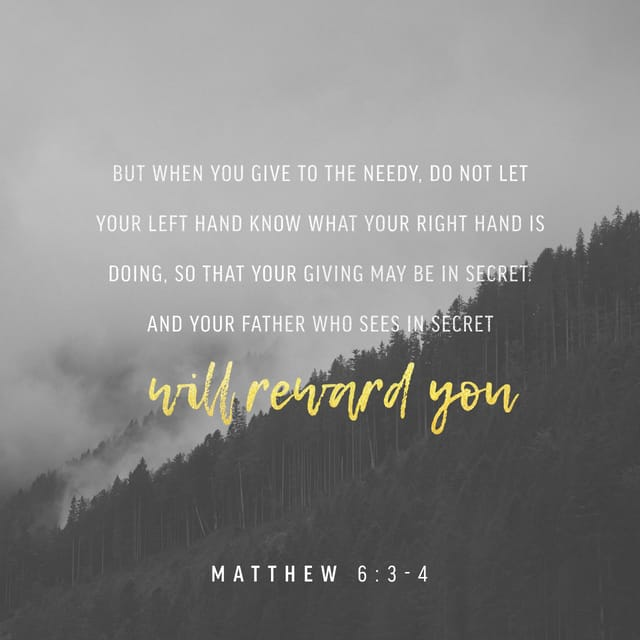
I wonder if the family who had brought the five loaves and two fish got to keep any of those leftovers…. The lack of any information about that is a lesson in itself: we may be asked to release our material blessings for the good of others without any guarantee that we will receive equivalent blessings in return, at least not on this side of heaven. Jesus teaches an important lesson about the mindset of His kingdom:

Borrowed from YouVersion

He does promise that we will be rewarded for our generosity–He just doesn’t say when we will be rewarded. It might not be until we get to heaven.

Borrowed from YouVersion

On the other hand, there’s a story in the Old Testament (1 Kings 17) where the reward for letting go of material possessions is immediate and significant. Elijah approaches a widow at Zarephath during a famine. This woman is about to bake her last bit of food for one final meal for her and her son before they die. Elijah asks her to give him those final morsels, but he also assures her she will have enough food until the famine ends. In an incredible act of faith, she complies. She lets go of the last bit of sustenance she has. She is rewarded right away for her faith. Not only does she end up with enough food to still make a meal for her and her son, but she also ends up with a supply of flour and olive oil that does not run out until the famine ends.

That’s great, of course, but I can also picture Jesus telling us that we should not do anything for His kingdom expecting an immediate return on what we have given. He wants us to want to let go of things because we are so thankful for what he has given up for us, and because His Spirit is helping us to see the world the way He sees it.

This post is already longer than I had anticipated, so I’ll briefly mention (without going into a lot of detail) that this idea of committing things for the good of God’s Kingdom and making the world a better place applies to our skills and abilities as much as it does to our material possessions–maybe even more so. It has always struck me that the Parable of the Talents that Jesus tells in Matthew 25:14-30 has a bit of a double meaning. I know the term “talents” was used to refer to money in those days, but it’s remarkable that today the word refers to the abilities we could use to earn money.

We need to be willing to commit our resources and our abilities to God. No matter how much or how little we have to give, He will multiply our offerings as needed to care for His flock.

He may even ask us to use talents we didn’t even know we had. He asked Peter, a fisherman with no theological training (other than following Jesus around for three years!), to preach his first sermon in front of thousands of people. Apparently, it went well. 3,000 people were converted as a result, and the new church of Jesus Christ was born.

Finally, Open My Hands for What I Will Receive

I’ll be brief here. As I mentioned earlier, I should not be expecting God to give me material blessings in return for what I might be giving up. But here’s what I can expect to receive:

Borrowed from YouVersion

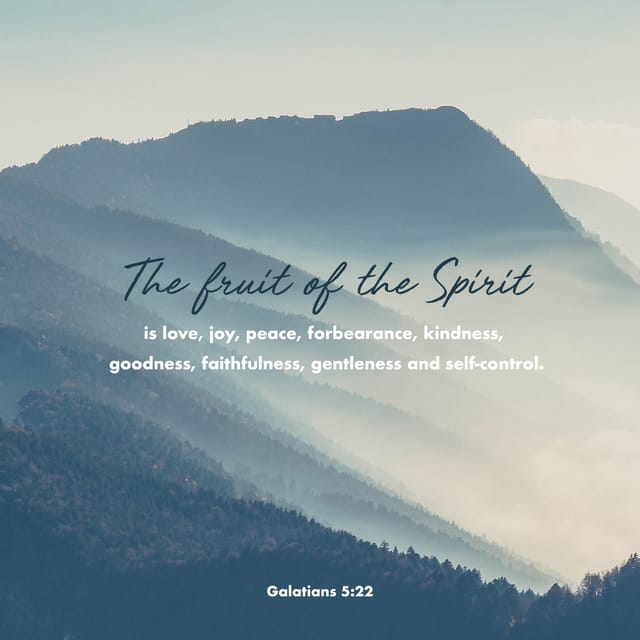
These are the blessings God will give me–and all of us–if we will receive them with hands wide open. As we remove obstacles to a deeper and deeper relationship with Him, He fills us with His Holy Spirit. In turn, we are blessed with things we all (and this broken world) could use more of–love joy, and peace, among other fruits.

This seems like a good exchange for whatever small thing God could be asking each of us to give up for the 40 days of Lent.

And now for something completely different–I’ve started a podcast in association with this blog. If you’d prefer to listen to the podcast for this post, here’s a link to the episode in Spotify. These episodes will also be available on your favorite podcast platform, so please search for “Master’s Canvas” there, or let me know which platform you prefer and I can provide the direct link. Happy listening!

Posted in Christian, Faith, Miracles | Tagged , , , , , | 2 Comments

Safe in the Everlasting Arms

After journeying through the Daily Audio Bible for 14 out of the last 15 years, I have grown to find comfort not only in the Scriptures, but also in the smooth voice of DAB’s primary reader, Brian Hardin. So recently, I decided to listen to the next day’s reading (he seems to upload them for the next day early each evening) as I am drifting off to sleep. I should note that I usually don’t even last 5 minutes before I fall asleep, so I listen to it again the next day.

In addition to helping me fall asleep so quickly, something else I really appreciate about this practice is that it makes me feel like I am safely nestled into God’s hands, like I’m protected by His strong, everlasting arms.

Which I am.

It has surprised even me how comforting I find this. So, no matter how stressful my day at work was, I rest easily. In spite of earthquakes or wars or rumors of wars, I find peace. Regardless of how the darkness can seem to be closing in, I drift off to sleep like a newborn baby drunk on milk.

I had to sneak in a picture of my grandson, Hudson, since he is so dang adorable (I might be a little biased…)

And here is this week’s confirmation that God was nudging me to write about this:  the day after this idea took shape in my mind, I encountered these verses in my daily devotional:

Created using YouVersion

So, if you find yourself anxious about anything, I invite you to join me. Crawl up into the everlasting arms of our loving Heavenly Father. There’s plenty of room for you here, and He never gets tired. In His strong hands is the perfect place to drift off to sleep, or to face any giants that might be threatening disrupt your day.

Posted in Christian, Faith | Tagged , , , | Leave a comment

No Condemnation…Not Even a Little

Not Even a Little Condemnation

You have disappointed God. I have disappointed God. Probably even made Him mad. More than once.

But here’s the amazing news of the Gospel–so good that it’s hard for people to comprehend:

Therefore, there is now no condemnation for those who are in Christ Jesus…

Romans 8:1 (NIV, emphasis added)

This was written by the Apostle Paul, who had also messed things up in a major way–so much so that Jesus knocked him off his horse on his way to Damascus. Knocked him on his butt and even blinded him for a time. But He got Paul’s attention.

I can only imagine what Paul’s spiritual journey must have been like from that point forward. God had kicked his butt for doing what he had been doing, but Paul had thought he was already doing what God wanted him to do. It must have been a rude awakening for him to realize that wasn’t the case. In fact, the way he was acting was exactly the opposite of what God wanted from him.

If it were me, I would feel a huge amount of guilt. I mean, Paul had been hunting down Christ-followers, dragging them to prison in chains. He must have had tremendous struggles, wondering how God could ever forgive him.

Yet somewhere in his journey, in his wrestling with God, he came to this revelation:

Because of what Jesus did, it doesn’t matter what I did. If I accept the gift of Jesus’s sacrifice, God does not condemn me.

Why does God choose to forgive us?

Here is the answer Paul arrived at through his discussions with Jesus:

…because through Christ Jesus the law of the Spirit who gives life has set you [or me] free from the law of sin and death. For what the law was powerless to do because it was weakened by the flesh, God did by sending his own Son in the likeness of sinful flesh to be a sin offering. And so he condemned sin in the flesh, in order that the righteous requirement of the law might be fully met in us, who do not live according to the flesh but according to the Spirit.

Romans 8:2-4 (NIV, emphasis added)

But You Don’t Know How Bad I’ve Been…

You may say, But you don’t know all the bad things I’ve done. And you’re right, I don’t. But God does, and He loves you anyway. And if you accept Jesus as your Lord and Saviour, then He also forgives you for every bad thing you have ever done or ever will do!

I can see how such a lopsided exchange would be hard for people to understand or accept. We are all about fairness and equity, but this trade is anything but fair or equitable. We give up eternal punishment for all the nasty things we have done. In return, God gives us grace, mercy, love, joy. Hope. Comfort in troubling times. A promise of eternity in paradise. Not really a fair deal for God, but we can sure make out well!

Even though it’s hard to understand, I still don’t get why more people aren’t lining up to make this trade. It’s the best deal I’ve ever seen!

It Really Doesn’t Matter

So, regardless of all the bad things you have done, you really should accept this offer. I had a pastor who said of his conversion experience, “I gave as much as I understood of myself to as much as I understood of God.” It’s a great line because it points out that you don’t need to understand all of the confusing things you have probably heard about God, Jesus, and the Bible. You just need to understand that God knows you better than you know yourself, and He loves you anyway. He stands knocking at the door of your heart, waiting for you to let him in so he can take away all condemnation for the bad things you’ve done.

It doesn’t matter if you have hated your neighbor or flipped off someone while driving. It doesn’t matter if you’ve been addicted to drugs or alcohol or pornography. It doesn’t matter what crimes you have committed or how many of the Ten Commandments you’ve broken. It doesn’t even matter if you are rooting for the Kansas City Chiefs in the Super Bowl.

There is nothing God can’t or won’t forgive you for. It really, really does not matter what you’ve done, because of what Jesus has done.

Like So Many Little Moons

I say this to myself as well. It is good for us all to be reminded that we do not need to live under a cloud of condemnation and shame. God has taken that away, and will take it away again and again, so that we can, like so many little moons, reflect the light of God’s Son into the darkness of the world around us.

Like So Many Little Moons
Posted in Christian, Faith | Tagged , , , | 3 Comments

Your Life Hidden in Christ

When I woke up this morning, the song “Abide” was going through my mind. And then at church, we sang that same song as we were preparing for communion. With God, I don’t believe in coincidences, so I asked God to show me why this song is at the forefront of my attention today.

I felt like He invited me to think about what it means to “abide in Christ”. What does that look like?

One thing that came to mind was the passage in John’s Gospel where Jesus talked about abiding:

“Abide in Me, and I in you. As the branch cannot bear fruit of itself, unless it abides in the vine, neither can you, unless you abide in Me.
“I am the vine, you are the branches. He who abides in Me, and I in him, bears much fruit; for without Me you can do nothing. If anyone does not abide in Me, he is cast out as a branch and is withered; and they gather them and throw them into the fire, and they are burned. If you abide in Me, and My words abide in you, you will ask what you desire, and it shall be done for you.”

John 15:4-7 (NKJV)

I had to switch to the New King James Version (which my Father-in-Law stands by as the only *true* translation 😊) to find where it’s translated as “abide”; in the translations I usually read, Jesus says “remain”.

Borrowed from YouVersion

These words are, of course, helpful and encouraging, but they don’t really explain what it looks like to abide in Christ. In my morning devotional, I came across this passage from Paul’s letter to the Colossians:

Therefore, as God’s chosen people, holy and dearly loved, clothe yourselves with compassion, kindness, humility, gentleness and patience. Bear with each other and forgive one another if any of you has a grievance against someone. Forgive as the Lord forgave you. And over all these virtues put on love, which binds them all together in perfect unity.
Let the peace of Christ rule in your hearts, since as members of one body you were called to peace. And be thankful.

Colossians 3:12-15 (NIV)

And I thought, That’s what it looks like to abide in Christ–to live and treat others in the same way that He lived and treats us. In the Common English Bible, the header for this passage is “Your life hidden in Christ.” So when I abide with Christ, my life is hidden in him because it’s not I who am exhibiting these desirable behaviors, but Christ in me.

So, do I live like this all the time? Unfortunately, no. But I do it more now than I used to. And when I don’t, when I fail, Jesus picks me up, dusts me off, and assures me, “We’ll get it next time.” Thankfully, His patience with me is endless.

His patience with you also knows no bounds, so don’t beat yourself up when you’re trying to abide in Him but you mess it up. Just keep asking for Him to teach you to abide in Him, and He will.

And be thankful.

Posted in Christian, Faith | Tagged , , , , , | Leave a comment

What Kind of Dirt Are You?

In the fourth chapter of Mark’s Gospel, he recounts Jesus’s telling of one of his stories that has come to be known as the Parable of the Sower or the Parable of the Soils, among other things:

“Listen to this! A farmer went out to scatter seed. As he was scattering seed, some fell on the path; and the birds came and ate it. Other seed fell on rocky ground where the soil was shallow. They sprouted immediately because the soil wasn’t deep.  When the sun came up, it scorched the plants; and they dried up because they had no roots. Other seed fell among thorny plants. The thorny plants grew and choked the seeds, and they produced nothing. Other seed fell into good soil and bore fruit. Upon growing and increasing, the seed produced in one case a yield of thirty to one, in another case a yield of sixty to one, and in another case a yield of one hundred to one.” He said, “Whoever has ears to listen should pay attention!”

Mark 4:3-9 (CEB)

I don’t know about you, but over the years, I have really struggled with some of Jesus’s parables, and this one is no exception. Evidently, I’m not alone, since in verse 10, Jesus’s disciples asked Him to explain it, which He did.

God is the One who sows the seeds, which is His word. We are the soil, the places where the seeds land. And, of course, Satan opposes allowing these seeds to take root in our hearts and mind, so he does everything he can to keep that from happening. How does he do this? One of his many strategies is to corrupt us in a number of ways, turning us into types of soil that do not allow God’s word to take root and transform us.

The Path

The first kind of soil is the path. It is packed and hard, keeping the seeds from even entering it. These are the people who are completely unreceptive to God. They have it all figured out. They think they are smarter than people like you and me, since we believe all of this (supposedly) outdated superstition called Christianity. I don’t mean to sound judgmental here–I was like this at one time myself, when I accepted the lies of the modern world and the evil one as truth. The only chance for people like this to recognize and accept the actual truth is for God to take a pick ax to their hearts, chipping away at it to soften it up and turn it into better soil. Thankfully, that’s what He did to me and for me.

Rocky Ground

People who are this kind of soil start off OK. They accept God’s words with joy in their hearts. However, it only remains in their hearts. It is only an emotional experience for them. This means that when something bad happens to them or someone they love, their faith falters.

Why is this? In my experience, cultivating a deep personal relationship with Jesus needs to be both an emotional experience and and intellectual one. Emotion and feelings may be what allows the seeds’ initial roots to take hold, but then thinking through your faith is what will enable them to run deeply into and throughout your life.

Life can be hard. Sometimes people are wicked. Even good people. And sometimes disasters strike. Health fails. It’s hard to understand why God allows these things to happen. Sometimes, it’s hard to even understand where God is when they happen.

When (not if) terrible things happen, if your faith has not gone deeper than the superficial emotional level, it can be rocked by those hard questions–God, why? God, where are you?

That’s the rocky ground, and that’s why Satan uses this tactic–so you have no answers to those hard questions.

Thorny Plants–Soil That’s Already Occupied

For this soil, everything might be great if not for the temptations of this world. The need for more. More wealth. More power. More sex. More stuff.

Most of these things might not be bad in the right context. God can use them, working through us, to advance His Kingdom. But one of the things Satan is extremely skilled at is tarnishing good things–spoiling them, making them bad. He knows that God commanded us not to put anything before Him in our lives, and the evil one also knows our natural tendency to do just that. So he helps us along down that path.

The Good Soil

We are good soil when we embrace God’s word, when we let it filter down into the depth of our being, both emotionally and intellectually. Is that where you are? If not, is it where you want to be?

The Gospel, the Really Good News

Here’s the thing: I don’t think we are ever completely one kind of soil, once and for all. I am trying to be good soil, but I have to admit that, sadly, it’s all too easy for me to slip into one of the other soil types.

But the really good news is that as soon as I recognize that I have slipped, I can ask God for forgiveness. I can reach out my hand and ask for His help. And He will help me!

He’ll do the same for you, too. He wants us to be good soil, so He will patiently help us get there. I can’t think of any news that’s better than that! Can you?

Photo by Gabriel Jimenez on Unsplash
Posted in Christian, Faith | Tagged , , , , | Leave a comment

Sing Until You Mean It

Each month, usually on the first Wednesday of the month, the church I attend (#NewLifeChurch) has a service dedicated only to worshipping God. I love all of the services at this church, and as much as I am enriched by the preaching in the “regular” Sunday services, I have to say that these worship services are my favorites.

In our most recent “First Wednesday” service, our senior pastor (#BradyBoyd) got up to welcome everyone after we had completed the first couple of songs. As he was speaking to us briefly, he observed how challenging it can be to come to church at the end of a busy workday and shift your mindset away from the day’s struggles. It’s tough sometimes to get into it, to really focus on worshipping God.

He said that when that happens to him, he just keeps singing until he means it, until the words he’s singing are true.

I wrote a blog post along these lines in July 2022 called “Feelings Follow Faithfulness“. It’s the same idea–show up, and the feelings will follow. Or, as the famous theologian (NOT), screenwriter, and director Woody Allen said, “Showing up is 80% of life”.

I imagine that King David must have dealt with this sometimes. Even though he was a man after God’s own heart (see Acts 13:22), he must have had days when he struggled to feel God’s presence. After all, there were periods in his life when people close to him were trying to kill him (first, King Saul; then later, David’s son Absolom). I can see how this would make you wonder–even if just for a moment–if God had abandoned you.

It makes sense when you consider how many times in the psalms that David wrote, he laments about what’s happening to him. He seems sad, confused, even distraught. But then, even after those melancholy words, he has a way of turning his psalms into songs of praise. He often seems to echo the words of Habakkuk:

Though the fig tree does not bud
and there are no grapes on the vines,
though the olive crop fails
and the fields produce no food,
though there are no sheep in the pen
and no cattle in the stalls,
yet I will rejoice in the Lord,
I will be joyful in God my Savior.

Habakkuk 3:17-18 (NIV)

It’s easy to imagine these guys struggling to praise God on the bad days they surely experienced. And yet, clearly, in the end they managed to do just that, to praise their Creator in the midst of chaos or disaster.

Maybe it is David’s ability to do this that led to him becoming a man after God’s own heart.

Because here’s the thing: when we make ourselves available to God, he begins working in us and through us whether we feel it or not. When we praise him even in times when we don’t feel like it, we are reminding ourselves of God’s loving presence, of his unfailing love. We begin to direct our minds and hearts to focus on the many blessings he gives us. Blessings we don’t deserve. We remember how great our God is. We are reminded of the incredible sacrifice he made for us.

And after a few songs like that, you can’t help but be engulfed in his presence, wrapped in his strong and loving arms. And before you even realize it’s happening, you mean the words you’re singing.

Posted in Christian, Faith | Tagged , , , , | Leave a comment

My Hiding Place

I’ve done things I wish I hadn’t. Haven’t you?

Of course you have, if you’re human. Screwing up is part of the human condition, at least until Christ comes back.

Starting early in the Bible, religious leaders started focusing on our tendency to do bad things. Things that were harmful to others. Things that separated us from God. Things that separated us from ourselves–our true selves, who we were intended to be. They lumped these bad things together into a category called “sin”. God gave Moses the Ten Commandment, and voila, we had a set of rules. Lines we should never cross.

But do you think God expected that we would be able to remain always on the right side of these lines?

Let’s look at it another way. God gave us free will so we could choose whether or not to follow him and nurture a deep, fulfilling relationship with him. And with that free will, God also gave us the ability to choose whether or not to live up to nearly impossible standards. Or to even try to live up to them. Do you suppose God expected that all of us would always make all the right choices, always choosing not to sin?

I think he may have hoped we would make the right decisions every time, but it doesn’t seem likely that he expected we would. Otherwise, why would he have launched a plan, way back when Adam and Eve made the first wrong choices, to rescue us and the world from ourselves (as alluded to in Genesis 3:15)?

Why Point Out Our Sins?

So why did God give us the Ten Commandments? To make us feel guilty?

No, not really. I think the overemphasis on guilt–on hellfire and damnation–is where religious leaders and “the church” have historically and traditionally gotten it wrong more often than not. As evidence of this, ask anyone you know who is not a follower of Christ what they think the focus of the Christian church is in the world today. I suspect you would hear more answers about shame, guilt, hypocrisy, and judgment than anything else.

Surely this is not what God intended, is it?

I don’t think so.

Here’s the thing: even without the Ten Commandments, God made us with an innate sense of morality. If this were not true, then atheists or other people who neither knew nor cared about the Ten Commandments would not have even a general notion of right and wrong. But they do. Why?

Because Breaking the Rules Breaks Us

Every time you or I commit even a “little” sin (even though there is no such thing, but we label them that way so we don’t have to feel as bad about it), it erodes us. It makes us a bit less than who we were made to be. And it opens the door ever so slightly more, allowing just a little bit more sin to creep into our hearts.

You may have heard it said that sin is anything that separates us from God, and that’s true. On top of that, this is how it happens that sin also separates us from our true selves, as I mentioned earlier.

That being the case, could it be that God gave us the Ten Commandments not so we would feel horrible about ourselves, but as a mirror, so we could see the truth about how ugly and misshapen we were allowing ourselves to become?

Well Maybe, But So What?

This is where it gets really good. God gave us this mirror to make us aware of our sin, of what we were doing to ourselves, to others, and to him. But he didn’t do this to make us feel bad about ourselves, except to the extent that we would turn to him for help.

Awareness of our sin is not meant to be a heavy, unbearable burden that we lug around, dragging into confessionals or therapists’ offices. Nope. Instead, it’s meant to turn us to the only One who can take away that sin. If we confess our sin completely and honestly to God, he will completely forgive us. He takes the burden away from us. He frees us from the guilt.

This is the exchange that took place between Christ and all of us who call him Lord at the moment of his crucifixion. He said, “I’ll take that which is breaking you and let it break me instead.” And in exchange, he gave us freedom from guilt. To borrow legal terminology, we are not just pardoned, we are exonerated, declared “not guilty.” It’s like we never did the bad things in the first place.

I can’t think of any news that’s better than this!

This is why it’s tragic that so much emphasis throughout church history has been on judging ourselves and others. It completely misses the “good news” side of the equation. The church should be known for grace, mercy, and forgiveness, not hate, bitterness, and judgment.

God Becomes Our Hiding Place Only When We Stop Hiding from Him

Psalms 32 is known as one of the seven Penitential Psalms. It describes repentance as a key step in the process of reclaiming wholeness for ourselves through the exchange with God at the cross. Verse 5 starts with:

Then I acknowledged my sin to you
and did not cover up my iniquity.
I said, “I will confess
my transgressions to the Lord.”

Psalms 32:5a (NIV)

Then and only then, after completely and honestly admitting our sin to God, will we be forgiven:

And you forgave
the guilt of my sin.

Psalms 32:5b (NIV)

Again, that’s great news–God forgives the guilt of our sin. But what happens to us if we do not completely and honestly confess our sin to God?

When I kept silent,
my bones wasted away
through my groaning all day long.
For day and night
your hand was heavy on me;
my strength was sapped
as in the heat of summer.

Psalms 32:3-4 (NIV, emphasis added)

So, it sounds like bad things happen to us, both spiritually and physiologically, until we recognize and confess our sin to God. Don’t try to hide from him. If you do, his hand will be heavy on you. I don’t know exactly what it would look like to have God’s hand be heavy on you, but I imagine it could range anywhere from depression and anxiety, to having the things you’re trying to hide becoming exposed. Yikes!

But God usually doesn’t deliver bad news without also offering a way out. This Psalm is no exception:

Therefore let all the faithful pray to you
while you may be found;
surely the rising of the mighty waters
will not reach them.
You are my hiding place;
you will protect me from trouble
and surround me with songs of deliverance.

Psalms 32:6-7 (NIV, emphasis added)

That brings us back to the really great news: you can give God all the rotten things you’ve ever done or said or thought. Dump all your garbage and filth on him. Tell him the truth. Then ask for and accept his forgiveness. He will carry away all of your burdens. All of your garbage and filth.

Then he will become your hiding place, your place of safety, your deliverance.

What a great deal! This is freedom. This is a return to God and the way we were meant to be.

Posted in Christian, Faith | Tagged , , , , , , , | Leave a comment

Spirit of Distraction

Much as it pains me to admit it, Satan is very good at his job. And what is his job? To separate as many human beings from God as he can. He hates love and loves hate.

One of Satan’s most successful methods he uses to keep us from developing a deep relationship with God is the spirit of distraction. This seems to be one of the pervasive themes in this technological age in which we live. There are many forms of entertainment and other distractions available to us across a multitude of devices–TVs, computers, phones, tablets, gaming consoles, smart watches, etc.

I should say that I am not in any way anti-technology. In fact, I have enjoyed a successful career that has been centered on helping companies achieve their business objectives through the effective use of technology. And I have at least one of most of the devices I listed.

Also, there are many examples of how technology is being used by followers of Christ for the benefit of God’s Kingdom. For instance, when COVID forced churches to close their doors, the church I attend (New Life Church in Colorado Springs, Colorado) and many others leveraged technology to enable us to continue to worship together virtually. Another great example is something I refer to regularly (just last week, in fact)–the Daily Audio Bible, which has used the internet to allow people of several different languages to feast each day on the spoken Word of God. Further, I humbly hope that this meager offering of a weekly blog, which encourages other followers of Christ in their walk with the Lord, is another good example of using technology for the advancement of God’s Kingdom.

But, as I mentioned, there seems to be a great temptation to turn our attention toward our devices and away from God (and each other, too). I say this not to accuse others as though I have not given in to this temptation. Sadly, I have. Instead, I point it out in hopes that we can collectively become more aware. Awareness equips us to get better at (or ask for God’s help in) resisting the temptation.

But here’s one really cool thing about God: every time we are diving into the depths of God but catch ourselves turning our attention from him to a gadget or any other distraction, we can repent and receive his forgiveness. And his arms will be spread wide, waiting for us to return to his loving embrace.

Photo by Nadine Marfurt on Unsplash

He wants to be known by us, so he will help us fix our gaze back on him.

Posted in Christian, Faith | Tagged , , , , | 2 Comments