September 11 is one of those dates that doesn’t need much explanation.
For those of us old enough to remember 2001, simply seeing 9/11 is enough.
We remember the airplanes.
The towers.
The smoke.
The Pentagon.
The field in Pennsylvania.
We remember watching something almost unimaginable unfold before our eyes.
And many of us remember exactly where we were when we first heard what was happening.
Twenty-five years later, the images are still difficult to comprehend.
As I write this, my wife and I are in Killarney, Ireland—a place that, at least from a visitor’s perspective, feels remarkably peaceful.
There is something almost jarring about remembering September 11 from here. Because during my own lifetime, Ireland was also a place where violence rooted in deep political, national and religious divisions regularly made the news.
I remember hearing about bombings and killings connected with the Troubles. For decades, peace in Northern Ireland sometimes seemed impossibly far away.
And yet, in 1998, people who had very good reasons to distrust one another chose another path. The Good Friday Agreement didn’t erase the history, heal every wound or eliminate every disagreement. But it helped bring an end to decades of widespread violence.
That’s worth thinking about.
Because peace doesn’t require pretending that our differences aren’t real. It requires deciding that hatred and violence don’t get the final word.
But this week, as I’ve thought about September 11 again, I’ve found myself thinking less about the people who brought violence into the world that morning and more about the people who ran toward it.
Firefighters.
Police officers.
Paramedics.
Ordinary people helping strangers.
Passengers on an airplane who realized what was happening and decided to act.
People who, in the middle of terror and chaos, chose courage, sacrifice and love.
And that has brought me back to something Jesus said:
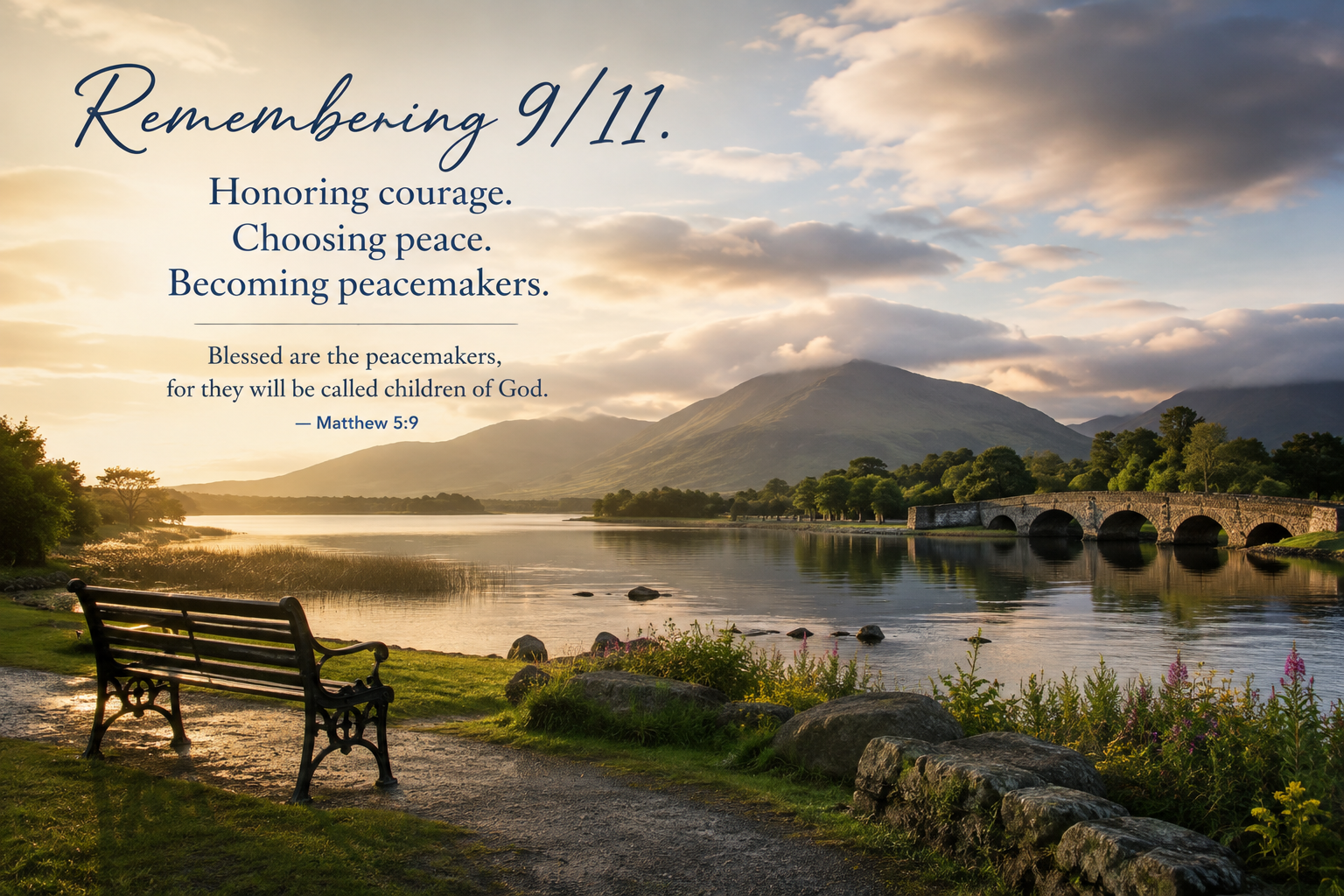
“Blessed are the peacemakers,
—Matthew 5:9 (NIV)
for they will be called children of God.”
I’ve read that verse many times.
But I’ve been wondering whether I’ve understood just how demanding it is.
Peace Is More Than the Absence of Conflict
When I hear the word peace, I tend to picture something quiet.
A calm morning.
A still lake.
A beautiful landscape.
A world in which, for a little while at least, nobody seems to be fighting about anything.
Those things can certainly feel peaceful.
But biblical peace is much bigger than tranquility.
The Hebrew idea of shalom points toward wholeness—things being as they should be.
Relationships restored.
People reconciled.
Justice and mercy meeting.
Fear giving way to trust.
Broken things being made whole.
That’s the kind of peace God is ultimately creating.
And apparently, He wants His children involved in the work.
Jesus didn’t say:
Blessed are the peace-lovers.
He said:
Blessed are the peacemakers.
There’s a difference.
Peace is something we can enjoy.
Peacemaking is something we do.
Peacemaking Is Not Passive
I think it’s easy to confuse being a peacemaker with simply avoiding conflict.
Don’t argue.
Don’t make anyone angry.
Keep your opinions to yourself.
Smooth things over.
Everybody just get along.
Sometimes those instincts are helpful.
Sometimes they’re cowardice dressed up as peace.
Jesus certainly wasn’t afraid of conflict.
He confronted hypocrisy.
He defended people others were willing to discard.
He spoke truth that made powerful people angry.
He overturned tables in the temple.
And ultimately, He went to the cross.
The Prince of Peace was not passive.
Which means peacemaking cannot simply mean keeping everyone comfortable.
Sometimes making peace requires courage.
Sometimes it requires speaking.
Sometimes it requires listening.
Sometimes it requires forgiving.
Sometimes it requires admitting that I was wrong.
Sometimes it requires standing between someone vulnerable and someone who wants to hurt them.
And sometimes it costs far more than we would ever want to pay.
What We Saw on September 11
I don’t want to romanticize what happened on September 11.
It was evil.
Nearly 3,000 people went to work, boarded airplanes, or simply began an ordinary Tuesday morning and never came home.
Thousands of families were changed forever.
And the consequences of that day continued for decades.
But evil wasn’t the only thing we saw.
We also saw people carrying other people down stairwells.
We saw first responders climbing upward while everyone else was trying desperately to get down.
We saw strangers helping strangers.
We saw people on Flight 93 choose to confront what was happening, knowing what it might cost them.
They couldn’t undo the evil that had already occurred.
But they could decide what they were going to do next.
There is something in that choice that profoundly reflects the character of Christ.
Not because every person who acted heroically that day was necessarily a Christian.
But because self-sacrificing love reflects the character of Christ whether the person demonstrating it realizes that or not.
“Greater love has no one than this: to lay down one’s life for one’s friends.”
—John 15:13 (NIV)
On September 11, we saw horrifying examples of what human beings are capable of doing to one another. We also saw extraordinary examples of what human beings are capable of doing for one another. Twenty-five years later, I think both are worth remembering.
What Kind of People Will We Be?
Most of us will never face anything remotely like what people faced that morning.
I hope we never do.
But the call to be peacemakers isn’t reserved for moments of national catastrophe.
It’s mostly lived out in much smaller places.
Our homes.
Our marriages.
Our friendships.
Our churches.
Our workplaces.
Our neighborhoods.
And, increasingly, the little screens we carry around in our pockets.
That last one may be one of the places peacemakers are needed most.
We live in a culture that has become remarkably skilled at making enemies.
Politics.
Religion.
Race.
Immigration.
Gender.
War.
Social issues.
Even relatively trivial disagreements can quickly become opportunities to sort people into teams.
Us.
Them.
Good people.
Bad people.
People worth listening to.
People worth mocking.
And Christians aren’t immune.
Sometimes we’re among the loudest participants.
Yet Jesus said something that leaves us very little room for that:
—Matthew 5:44 (NIV)
That’s considerably harder than winning an argument.
The Peace Jesus Gives
There’s another reason Christians should be able to become peacemakers.
We don’t have to manufacture peace ourselves.
Jesus gives it to us.
Shortly before His crucifixion, He told His disciples:
“Peace I leave with you; my peace I give you. I do not give to you as the world gives.”
—John 14:27 (NIV)
Notice the order.
Before Jesus asks us to carry peace into the world, He gives His peace to us.
That’s important.
Because it’s difficult to bring peace into a room when there isn’t any peace inside me.
If I’m consumed by fear, I’m likely to spread fear.
If I’m filled with anger, I’ll probably spread anger.
If I see everyone who disagrees with me as an enemy, I’ll keep creating enemies wherever I go.
But if I am learning to live in the peace of Christ, perhaps I can bring something different with me.
Calm instead of outrage.
Curiosity instead of accusation.
Grace instead of contempt.
Truth without cruelty.
Conviction without hatred.
Forgiveness instead of revenge.
Not because I am naturally capable of those things.
Because Christ is changing me.
Children of God
That brings me back to the second half of Jesus’ statement:
“Blessed are the peacemakers,
for they will be called children of God.”
Why children of God?
Perhaps because children often resemble their Father.
Our God is a peacemaker.
Humanity rebelled against Him.
We broke the relationship.
We created the separation.
And God didn’t wait for us to figure out how to repair it.
He came looking for us.
Paul writes:
—Colossians 1:19–20 (NIV)
That is the heart of the gospel.
God made peace with us at enormous cost to Himself. And now Jesus says to those of us who have received that peace: Go make some.
Twenty-Five Years Later
Twenty-five years have passed since September 11, 2001.
A generation has grown up knowing that day only as history.
For the rest of us, it remains something more personal.
We remember.
And we should.
We should remember those who died.
We should remember the families who lost people they loved.
We should remember the first responders.
We should remember the courage.
We should remember the sacrifice.
But perhaps remembrance should do more than make us look backward.
Perhaps it should make us ask what kind of people we want to be now.
The people who attacked America that morning demonstrated the terrible power of hatred.
The people who ran toward danger demonstrated something else.
Courage.
Sacrifice.
Love.
Twenty-five years later, hatred still isn’t difficult to find.
Neither is fear.
Neither is division.
What seems considerably harder to find are people willing to step into those things carrying peace.
Perhaps that’s one of the lessons of the country I’m visiting as I write this. Peace can seem impossible—right up until people begin doing the difficult work of making it.
Jesus says those people bear a family resemblance.
“Blessed are the peacemakers, for they will be called children of God.”
I don’t know that I’ll ever be asked to run into a burning building.
I pray I won’t.
But today I will almost certainly have opportunities to make peace.
To listen instead of attack.
To forgive instead of retaliate.
To lower the temperature instead of raising it.
To treat someone who disagrees with me as a person God loves rather than an enemy I need to defeat.
To bring a little bit of God’s shalom into a world that desperately needs it.
Those choices won’t make the history books.
Most of them won’t even be noticed.
But perhaps that’s how peace usually enters the world.
One conversation.
One relationship.
One act of forgiveness.
One courageous act of love at a time.
And twenty-five years after a day that showed us just how destructive hatred can be, maybe one of the best ways we can remember is to become the kind of people Jesus called blessed:
Peacemakers.


Peacemakers – love this! I will never read that verse the same way again. My hubby was in law enforcement for 12 years, and trying to de-escalate everyone’s drama for that long is work, which cost him a lot.
Thank you so much for sharing this. It really means a lot to me to hear that this gave you a new way of seeing that verse.
And please thank your husband for his 12 years of service in law enforcement. I can only imagine how much patience it takes to spend day after day stepping into difficult situations, trying to calm people down and bring peace where there is conflict—and, as you said, that kind of work can come at a real personal cost.
It strikes me that so much of what good law enforcement officers are called to do is exactly that: be peacemakers. Not simply keeping order, but patiently working to de-escalate situations when emotions are running high. That takes a special kind of patience and strength.
Thank you again for reading and for sharing such a personal connection to this. God bless you both!
This was wonderful. Your insight helps make this so clear and moving. Thank you.
Thank you, sweetheart. That means more to me than you know, especially coming from you. You see not only the finished words, but so much of the journey behind them. I’m grateful for the way you encourage me, support me, and walk alongside me as I try to follow wherever God is leading. I love you. ❤️