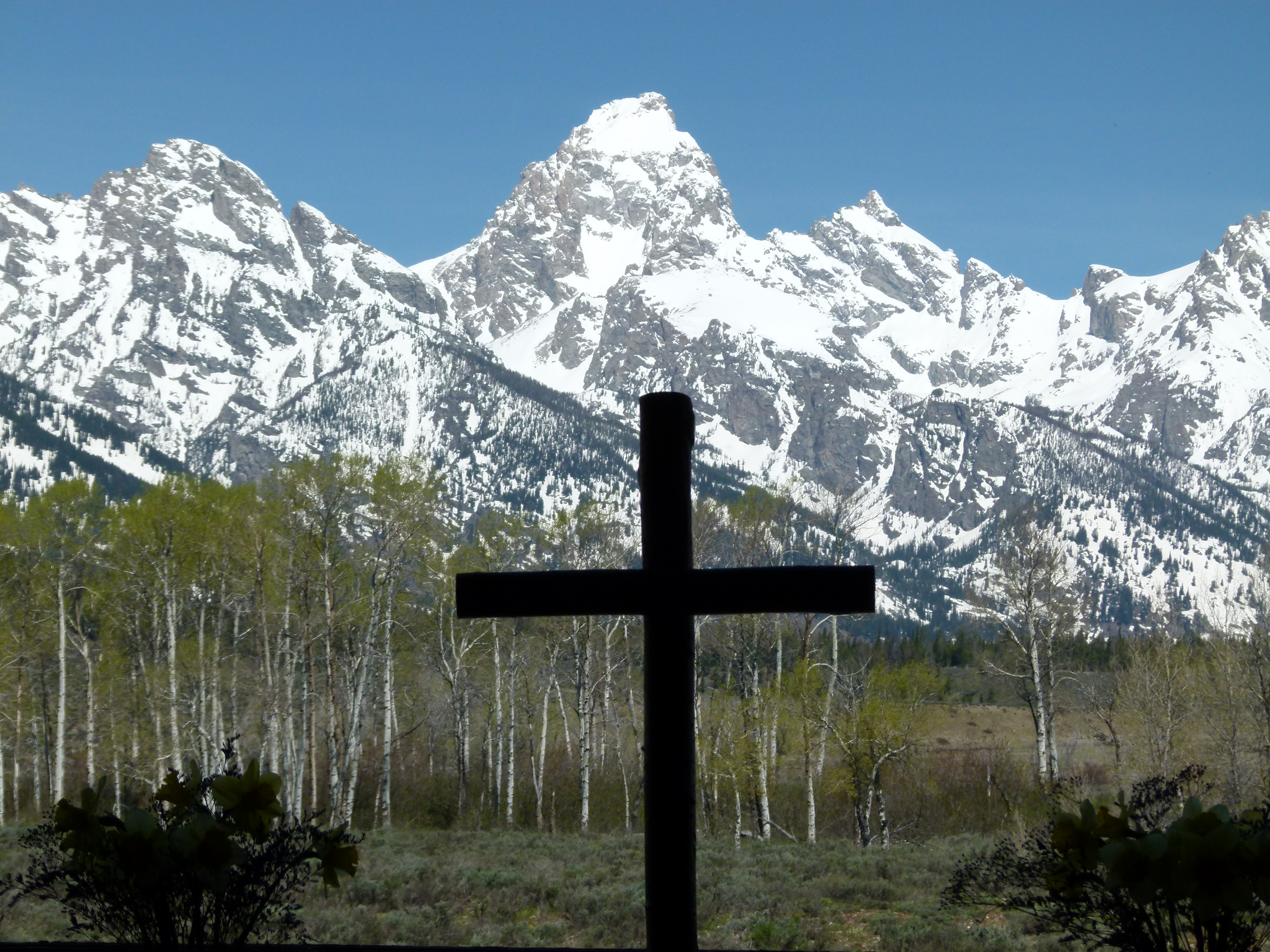
As recounted by the Apostle John, the last thing Jesus says on the cross before he dies is the Greek word tetelestai, which is commonly translated as, “It is finished” (John 19:30). What did he mean by this? That this terrible ordeal was finally over?
I don’t think so. His whole life had been pointing to the cross. This was not something to be over with in one horrible day.
(C) Copyright 2021 by David K. Carpenter Photography, All Rights Reserved
Jesus had previously clarified that nobody takes his life from him , but that he willingly lays it down (John 10:18). Similarly, here I doubt he would end his earthly life by saying something like, “OK, now that’s over.” Rather, I think he would mean something more like, “I did what I came here to do.”
And what is that, exactly? What did he come here to do?
Start a religion? Nope.
Give us a reason to feel special and better than those people? Nope.
Give us a rule book? Take away all our fun? Make us get a haircut or squirm when someone drinks or dances or plays cards? Not even close.
The Beautiful Exchange
Jesus came to offer us a great deal.
Early in this season of Lent, it occurred to me (and so I posted about it) that as we grow in deeper relationship with him, we shouldn’t focus on the paltry things we give up by choosing to follow him. Instead, we should focus on what Jesus freely gives us in return.
Nowhere is this beautiful exchange more starkly contrasting than in the sacrifice Jesus makes for us on Good Friday.
Evil can flow all too easily through the dark rivers of our hearts. But just like the priests with Joshua stepping into the Jordan river (Joshua chapter 3), Jesus puts one foot into those rivers of darkness and stops them from flowing.
Jesus takes the punishment we deserve for a lifetime of evil thoughts and actions. In return, he gives us life eternal in paradise.
Jesus takes the curses we’ve hurled at him and his sons and daughters, and gives us blessings in return.
Jesus takes our fear, uncertainty, and doubt. In exchange he gives us hope and peace and joy that should baffle those around us. He takes our burdens and gives us rest.
Jesus takes our grumbles and replaces them with gratitude.
(C) Copyright 2021 by David K. Carpenter Photography, All Rights Reserved
Consider the Cost
I can’t imagine why I ever thought it would cost me too much to follow Jesus. Look at how much it cost him to have me as a follower. Sitting at the foot of the cross, I can’t escape the fact that it cost him everything to pay my debt. But thanks to him, it is paid in full, now and forever.
Jesus is hanging out with his friends in Caesarea Philippi when he asks them, apropos of nothing, “Who do the people say the Son of Man is?” (Matthew 16:13, NIV)
They provide a variety of answers, so he turns the question directly to them.
“But what about you?” he asked. “Who do you say I am?”
Jesus, in Matthew 16:15, NIV
Now picture him leveling his gaze on you and asking you the same question.
“What about you, Dave? Who do you say I am?”
He continues, a bit more pointedly. “Who does your life say I am?”
Hmm. I have to think about that one, every dumb thing I did or said, just in the last week, flashing through my mind….
But just when the silence becomes awkward, he smiles, a twinkle in his eye. “Here’s who I say you are: my beloved, my friend. Someone I choose to give my life for.”
Oh my. What can you say to that? If you think deeply about it, does it change your answer to his questions?
“What about you, <your name here>? Who do you say I am?”
Palm Sunday
And so the journey
To the cross begins with
A choice:
You climb not on a
War horse, but an
Animal of peace. But really?
A donkey? This isn’t
What I expected. A god made in my image
Would win the war and save us all.
Ugh. Turn over this table
In my heart—disappointments, not
Meeting my expectations of You.
Disrupt wherever I hold fast to
Cheap imitation truths.
Take out the garbage—anything
Not from You.
Kill it on a cross, like I
Did to You, and will do again this Friday.
Break me, make me
To be what You expect from me.
Hosanna! God save me from
Myself,
You know I can’t do it on my own,
Even though I never stop trying.
David K. Carpenter
March 28, 2021
(c)Copyright 2021 David K. Carpenter, All Rights Reserved
(c) Copyright 2021 David K. Carpenter Photography, All Rights Reserved
As we head into Holy Week, we start off with the massive celebration commonly referred to as Palm Sunday. Getting caught up in the festivities, we might be tempted to think that Jesus could have enjoyed this moment of notoriety. After all, who wouldn’t like to be greeted upon their arrival into a new city with shouts of “Blessed is he who comes in the name of the Lord!”?
However, Jesus knew exactly what was waiting for him on the other side of this triumphal entry…
Many of these same people would be standing by the side of the same road in 5 short days watching him drag his cross out of Jerusalem toward Skull Hill.
One of his disciples would sell him out for 30 pieces of silver. His closest friend would act like he didn’t know him.
Probably worst of all, he knew God himself would turn his back on him–the only thing he complains about throughout the entire ordeal we refer to as Good Friday.
He knew all this was going to happen before he even headed for Jerusalem one last time.
So why did he do it?
Because if he didn’t, he knew you and I would be eternally separated from God because of all those times we’ve screwed up. Someone had to pay the price for the sins of the world, and he knew it could only be him.
So he went.
I can’t think of a better way for someone to show me how much he loves me–for Jesus to lay down his life willingly for me so I can live; for God to allow the sacrifice of his only son so I can run into his arms instead. This is grace; it is Love in action.
I don’t mean to dampen the celebration that is Palm Sunday. I only suggest that we all take a moment amidst waving palm branches to ponder that Jesus’ sacrifice for you and for me began the moment he climbed onto the donkey’s back to begin his long ride into Jerusalem and toward the cross.
(c) 2021 David K. Carpenter Photography, All Rights Reserved
Anyone still journeying along on this wild ride through Scripture in one year has most likely encountered this odd little story at the end of Luke’s second chapter–the one where Mary and Joseph lose the Creator of the Universe when he was twelve years old.
They were in Jerusalem for the Passover, which they attended every year. When it was all over, they packed up all their stuff and left to begin their 90-mile trip home. Except they forgot one little thing: Jesus.
And it’s not like they just got to the corner and quickly saw he wasn’t there–it took a full day before they noticed he was missing!
I can only imagine the uncomfortable conversation between Joseph and Mary when they realized this.
Mary: “Uh, have you seen Jesus?” Joseph: “What do you mean? Of course I’ve seen him. He hangs around my workshop all the time. He hardly ever stops talking.” Shakes his head. “Oy, so many questions.” Mary: “No, I mean today. Have you seen him today?” Joseph: “I thought you had him.”
And so on–I suspect Mary’s response to Joseph at this point may not be fit to print in a Christian blog.
To be fair, they made this annual trek to the Holy City with a large extended family group, and undoubtedly the kids hung out together and drifted between the different families. It could happen to anybody, right?
On a more serious note, after the extraordinary lengths they had to go to just to keep Jesus alive for the first couple years of his life, this must have been terrifying for these parents. On top of that, it was another four days before they found him:
When they did not find him, they went back to Jerusalem to look for him. After three days they found him in the temple courts, sitting among the teachers, listening to them and asking them questions.
Luke 2:45-46 (NIV)
Another day’s journey to get back to Jerusalem, then three days looking for him. They probably looked everywhere before they checked at the temple. I mean, what kid voluntarily goes to church?
When they finally found him there, they paused being freaked out just long enough to be astonished that everyone in the temple courtyard–which would be all the really smart religious leaders–was amazed by his understanding and answers. But then mom got hold of herself and asked Jesus what the heck he was thinking and how could he do this to them.
Jesus’ answer to her was as baffling to his parents as this story may be to us:
“Why were you searching for me?” he asked. “Didn’t you know I had to be in my Father’s house?”
Luke 2:49 (NIV)
At least this little episode has a happy, if not a little confusing, ending.
It may be both tempting and appropriate to ask why this little story is here. Luke’s is the only gospel that mentions it. So why did he include it? As with most Bible stories, there are probably several reasons, and at multiple levels.
One possible answer is that it shows us it’s OK to lose Jesus. I know I did at one point in my life, when I wandered unsuspectingly into the desert only a couple years after finding myself in the verdant pastures of rebirth. I believe all three of my kids lost Jesus, but my oldest has found him again. And so have I.
It’s OK to lose Jesus as long as you never stop looking for him again.
Oh, I know, when you’ve lost him, you wouldn’t say you are looking for him. You’re looking for something, you’re just not quite sure what it is or where you’ll find it. So you look in all manner of strange places that this world has to offer. Escapism, like alcohol, drugs, sex, music. Career success. Enlightenment (how ironic that most who call themselves enlightened are often as far from the truth as you can possibly be!). Family, friends. The mall or Amazon. And so on–the list is as long as the human mind is creative and depraved.
But not all of these things are bad in and of themselves. They are just ersatz answers, cheap knock-offs of the true peace and fulfillment that can only be found in the Source of All Answers.
It’s important to note, though, that there’s good news for us when we lose Jesus, or when someone we love has lost him:
Last week I blogged about fighting the temptation to the sin of worrying, which is to say, failing to trust God. One comment I got said something to the effect of, “That’s good and makes sense when I read it–but how do I do it?”
It’s a great question, and of course, more broadly it applies to all sin. How are we to resist temptation? Easier said than done, as we all know. I should note that by writing this blog, I by no means claim to be perfect or anything close to it–God knows all too well that I screw up as much as the next person.
Nevertheless, I feel called to provide God’s guidance for resisting temptation, which in my better moments has helped me fight against Satan and resist the temptations and justifications he so freely offers me.
Let’s start by pointing out a couple key promises from God.
Since sin separates us from God, but God wants us to be closer to Him than a best friend, logic would dictate (and Paul states in his first letter to the Corinthians) that God does not want us to sin (and by the way, this is the reason He doesn’t want us to sin, not because He’s an angry, vengeful judge following us around, waiting for us to screw up; otherwise, He would not have sacrificed His only begotten Son to reconcile us back to Him by paying the price of our sin, thereby wiping our slates clean!). As Paul points out here, God will always show us a way out of the temptation.
Note that there are multiple ways out, methods for resisting temptation, some of which we’ll talk about here. There are many more, with volumes of books and articles written about them. If there’s a specific temptation you grapple with and wish you could change, I suggest you find literature directly related to that temptation, or even seek help from a behavioral health professional or your pastor.
Moving on, if we are inclined to think of God as an angry referee who has no idea what it’s like to face overwhelming temptation, we should remember that Jesus was fully human. This means He was saddled with the same human nature that courses through all of our lives. And even though the world has changed significantly in the last two-thousand years, human nature has not. This in turn means that Jesus knows exactly how we feel and what it’s like to face temptation.
OK, so how did He do it? Can we use the same methods Jesus did to fight against the evil one? YES! That’s the point of emphasizing the fact that Jesus was fully human. He had no special magic that exempted Him from temptation. The good news about this is that we have available to us the same tools that Jesus used. Granted, He used them better than we generally do, but this is what living a sanctified life means–that we allow God to transform us more and more into His image.
For one thing, Jesus modeled for us a life of a constant and ongoing conversation with God, which is to say, prayer. When tempting thoughts toward sin creep into our minds, we can (and should, as it is a sign of maturity) practice recognizing that. When we take hold of such a thought, a prayer as simple as, “Help me, Jesus, I can’t fight this without you,” may be all you need to resist the devil. Maybe not, but it’s at least a good start.
We also see Jesus use prayer to resist temptation in Gethsemane garden on the Mount of Olives right before He was arrested, beginning that horrible journey, which He knew was coming, toward torture and death on the cross. He clearly was tempted not to go through with His sacrifice–and who could blame Him? Luke recounts that He was so conflicted and distraught over this that an angel came to strengthen Him:
Jesus went out as usual to the Mount of Olives, and his disciples followed him. On reaching the place, he said to them, “Pray that you will not fall into temptation.” He withdrew about a stone’s throw beyond them, knelt down and prayed, “Father, if you are willing, take this cup from me; yet not my will, but yours be done.” An angel from heaven appeared to him and strengthened him. And being in anguish, he prayed more earnestly, and his sweat was like drops of blood falling to the ground.
Luke 22:39-44 (NIV, emphasis added)
“Not my will, but yours be done.” How many inappropriate actions could we avoid if we included that in our quick prayer to help us resist temptation?
Lastly, I’ll point out that the other tool which Jesus used frequently to fight the devil was God’s word. This, of course, is also freely available to us in many forms. One of the many reasons why God wants us to be immersed in His word is so we can use it as armor when (not if) we find ourselves in battle against Satan and his temptations. Whatever your struggle is, there’s a Scripture that will be useful for you in defending against those attacks. If you pray about it, God will help you find it.
The most well-known model of Jesus doing this was when He was tempted by Satan after 40 days of fasting in the wilderness, as His earthly ministry was getting started. The story is captured in Matthew chapter 4, verses 1 through 11. The evil one tempts Jesus three times, even quoting the word of God in the process (inappropriately, of course). Each time, Jesus refutes Satan with Scripture.
Last week I wrote about the holy exchanges God offers us, which are always great deals for us. Now I want to unpack one of the trade-offs that I glossed over last week just a bit more.
Jesus offers to take this sin away from us: to carry all of our anxious thoughts, all of our fears, all worries we have about tomorrow or next month or next year.
Woah, hold on a minute! you might be thinking. Since when is worrying a sin? I don’t remember seeing that in the Ten Commandments.
It’s a fair question. Without going too far down a theological rabbit hole, let me assert that anything that puts you in opposition to or apart from God is sin. And although it’s not a rule from the Ten Commandments (sadly, breaking these is far from the only way we can sin), Jesus addresses it directly in his Sermon on the Mount:
“Therefore I tell you, do not worry about your life, what you will eat or drink; or about your body, what you will wear. Is not life more than food, and the body more than clothes? Look at the birds of the air; they do not sow or reap or store away in barns, and yet your heavenly Father feeds them. Are you not much more valuable than they? Can any one of you by worrying add a single hour to your life?”
So, are you with me? If Jesus explicitly tells us not to do something, I’m thinking it’s a good idea not to do it. But even setting that aside, it’s also not a good idea because it doesn’t do any good! If we think about why Jesus tells us not to worry, his rhetorical question says just that: who of us can add even a single hour to our lives by worrying?
If I had to guess (although of course I’m not God and his ways are higher than mine just like everyone else), I would say that the problem with fear and worrying is that it conveys a lack of trust in God. It’s easy for us to say we trust God, and even easy for us to believe that we trust God completely when things are going well. But what if an outcome isn’t what we wanted? Or if the answer doesn’t come when we want it? Do we still trust him then, do we still believe that his plan is to prosper us (as one of my favorite verses seems to promise)?
This is clearly more challenging. To some degree, we tend to behave like spoiled children when it comes to God–I want what I want when I want it! So God, if you really love me, you’ll do this thing for me, right?
Every good parent knows you can’t give your kid everything s/he asks (begs, pleads, cries) for, knowing that doing so takes away any chance they have to build character, not to mention the fact that we know some of the things they ask for won’t be good for them. So why should we expect God to be any different with us?
So anyway, I hope we’ve established by now that worrying, living in constant fear, and not trusting God are all counterproductive things for us to allow into our lives. But what are we to do? Sometimes these thoughts appear in our minds. But what if this happens…? We can’t help that.
But why not?
Every sin, including this one, begins with a single thought. We don’t need to remain slaves to our thoughts–we can and must capture negative or sinful thoughts the moment they occur. To have had the thought is not a sin–we can’t help what pops into our minds. It is acting on the thought, or allowing it to run wild in our minds, that leads us down the path toward sin.
Once we have captured a rotten thought, instead of allowing it to drag us down that well-worn path toward hell, we need to replace it with something godly.
Lately, I’ve been experimenting with recalling a scripture to mind, which Jesus modelled for us when Satan tempted him after 40 days in the wilderness. Or if I can’t think of one, I’ll open the Bible app on my phone and read a few verses. When I do that, I actually end up feeling glad that I got tempted since it gave me the opportunity to turn to God (through his word) to overcome the temptation. What Satan meant to harm me and destroy me, God turns it into something good. What a great plot twist!
This is one version of a holy exchange–trading a temptation for a word of encouragement and strength from God. There’s another version, which I’ll wrap up with: when we are tempted by fear or worry, Jesus offers to carry those things for us. He’ll take that baggage onto his strong shoulders.
I’ve gotten pretty good over the years at catching myself worrying and handing it over to Jesus. Of course, it’s still an ongoing struggle not to stomp over to him and yank it back out of his hands! Hey, growth is a process. I just keep reminding myself that in exchange for my troubled mind, Jesus offers his perfect peace–the shalom that King David wrote about in the 23rd Psalm:
Even though I’m not Catholic, I took up the practice of Lent (the 40 days leading up to Easter that begins with Ash Wednesday) many years ago. This is a great invitation to reflect on and prepare our hearts for the awareness of the ultimate and tremendous sacrifice by God the Father and God the Son that crashes into our story during Holy Week. The idea is that we should fast from something during this time. This could be a particular kind of food (chocolate?) or activity (watching TV), etc. It’s up to each individual to choose what to give up.
Although I have to confess I haven’t always been great about this, the idea is that whenever you consider partaking in whatever you gave up for Lent, you are to use this as a reminder of the coming sacrifice that Jesus made for us. For whatever reason, though, this year has been different for me. I have been more mindful of that, and thinking of my small sacrifice has led me to reflect more about the huge sacrifice Jesus made for me.
And here’s the thing I have come to realize: this holy exchange, as well as every exchange I make with God, is always a better deal for me than it is for God.
We’ll ponder the ultimate exchange–my sin for the righteousness of Christ–as we get closer to Easter, so for now I want to focus on this idea: shrouded in the darkness of this age, people who are not yet followers of Christ (and even some who are) tend to think about church and Christianity in terms of what you have to give up: lying, cheating, stealing, murder. These may be easy enough to avoid, but what about swearing? Some would also add gambling, dancing, certain kinds of music, dressing in a certain way, but I’m not convinced there’s a biblical foundation for these.
Anyway, the point is, when you focus on negatives like this, you miss the big picture. The Bible isn’t a rule book, it’s a love story. God wants us to be in relationship with him. The things He asks us to avoid are not healthy for any relationship. If I lied to or cheated on my wife, those actions would not be healthy for our relationship.
Also, as for most (if not all) of the other rules found in the Bible, God gave them to His people to form them into His people. If you’re reading through the Bible in a year, you’ve probably reached the part in the story of the Israelites where they were wandering in the wilderness on their way to the promised land. He gave Moses the 10 Commandments and other rules to give to the people so He could create a culture for His people that was unlike anything man had dreamed up. He created boundaries to protect their health as they moved through the wilderness since they couldn’t just pop over to a nearby pharmacy or Emergency Room if they got ill.
If I turn my attention away from the negative of what I have to “give up” and instead focus on the positive of what it means to be in relationship with God, here’s what I get in return: I get an assurance that no matter what happens to me in this life, I know I will spend eternity in paradise with my Creator and all of my loved ones who are or become followers of Christ. I get a deep-rooted peace that surpasses all understanding–shalom–even as I navigate the often turbulent waters of this life. I get the gift of appreciating people for who they are–sons and daughters of God–instead of what they can or can’t do for me, or any other sub-optimal way of viewing people. I could go on and on, but I’m trying to keep my posts brief.
So what’s the bottom line? We all should be glad to make holy exchanges with God since we always receive more from Him than we have to give up to be in relationship with Him. Thanks be to God, from whom all blessings flow!
Since I am not God, I obviously have no way to be certain, but I would not be surprised if one of the more common prayers He hears is for healing, both for the person offering the prayer and for loved ones. Nobody likes to suffer, and even more than that, we don’t like to see our loved ones suffer, so it makes sense to me that this would be a common prayer.
What doesn’t make sense, though, is the apparent absence of an answer from God. I mean, I believe in a loving, all-powerful God with the ability to do anything He wants. So why would He ignore such prayers? How could he, instead, take loved ones from us in spite of our pleas to the contrary?
It doesn’t seem fair.
I have no argument for that. I agree, it’s not fair. To say it sucks is an understatement.
There are, of course, platitudes people will offer–well-meaning people trying desperately to find something comforting to say–but that in the end crash to the floor and shatter like a china teacup. She/He is in a better place. God must have needed another angel, so He called him/her home. Blah, blah, barf.
The only thing I can think of isn’t really very comforting, but it probably best fits with who I believe the Bible tells us that God is: I believe that upon passing through death, followers of Christ are restored into some form that is healthy and fit enough to last for all of eternity. So sometimes when we pray for healing, we or our loved ones are truly healed–just not in the way we think of healing, not in the way we want. We or they pass through death and are made whole. This doesn’t help those of us left behind since we see it as that person being taken from us. But that person’s suffering is over.
I warned you it wasn’t all that comforting.
But there is good news. God isn’t willing to have anyone face eternity without giving them an opportunity to accept Jesus as their Lord and Savior. There’s underlying theology here, about how and when that choice happens, and is this opportunity presented (again) after we die, that I’m glossing over for now since that’s deeper than I want to get right now. What I’ll point to instead is the story of the vineyard workers that Jesus told in Matthew chapter 20.
Jesus’ point in telling this parable is to let us know–especially those of us who have been following Him for years and may have an over-inflated and worldly view of what’s fair–that even people who accept Him into their hearts at the last possible moment will enjoy the same benefit of eternity with Him in paradise as those of us who have been toiling away as His followers for many years. To underscore this point, look at what He said to one of the thieves on the cross right next to Him, who professed his faith in Jesus only hours before he died:
This still may not give us any comfort when a loved one is ripped from our grasp, taken away too soon. But in some small way, perhaps it can bring a measure of hope that we can one day be reunited with them in paradise.
In memorium: for Kathy. We all miss you more than we had the chance to tell you before you were gone too soon.
Have you ever run into a dead end, an end of the road that you hadn’t expected? Did you wonder when–or even if–God was going to show up to make things right?
You’re not alone. Anyone who has developed an honest relationship with God has asked a question something like, “Where are you, God? How can you let this happen to me?”
This is the way the Israelites felt in Exodus 14. They had finally escaped from Egypt, only to look over their shoulders to see that Pharaoh had changed his mind and was chasing them after all. With the full might of the Egyptian army. When the Israelites reached the Red Sea, there was nowhere to go. They were trapped. Gulp.
Of course, everyone blamed Moses, telling him it would have been better to remain slaves in Egypt than to die in the desert. Moses responded with a great statement of faith and trust in God:
“Do not be afraid. Stand firm and you will see the deliverance the Lord will bring you today. The Egyptians you see today you will never see again. The Lord will fight for you; you need only to be still.”
Moses, in Exodus 14:13-14 (NIV)
And of course, anyone who knows the story of how God parted the Red Sea to save the day, allowing the Israelites to pass through (but brought it back together to drown the entire Egyptian army) is aware that Moses was right. But here’s the thing:
The solution to their problems didn’t come when the Israelites wanted it–they would rather have been rescued when things first started getting bad. Who wouldn’t? But this answer came years later.
This solution undoubtedly doesn’t look anything like what the Israelites would have been hoping for. But it was still a solution.
The Bible is full of stories about God coming through for His people. Life is full of stories about God coming through for you and people you know. His answers to our prayers may not come when we want or in a form we want, but they will come. We have to trust Him that where there is no way, He will make a way. It’s what He does. His ways are higher than our ways, so we probably won’t understand how He is working on our behalf until sometime later, when we reflect back on our challenges and count the ways He parted the Red Sea for each of us.