Over the years, we have given names to some of the days in Holy Week: Palm Sunday, Maundy Thursday, Good Friday, culminating in Easter–which is technically what comes next, a new week all its own. And a new way of living. But I’m getting ahead of myself.
So, I’ve been wondering what Jesus was doing all the other days this week and why they didn’t get special names. Could it be he wasn’t doing anything significant on Tuesday? I really doubt that, so I thought I’d propose some possible names for the Tuesday of Holy Week, sort of like Taco Tuesday, which sounds delicious but doesn’t quite have the eternal impact of the other days’ names.
How about “Jesus tells the religious people to stop being religious and focus on their relationship with God instead” Tuesday? Possible, but not very catchy.
“Jesus prepares his friends for the road ahead” Tuesday?
“Jesus shows up for us even when we don’t know it” Tuesday?
“Jesus never leaves us” Tuesday?
“Jesus, why aren’t you healing my friend” Tuesday?
“God’s ways are beyond my ways” Tuesday?
“Jesus, I need you” Tuesday?
Hmm, I guess I’m not very good at slogans or day naming. But I hope you get the point anyway…
This first day of Holy Week is called Palm Sunday because the people of Jerusalem were so excited about Jesus’s arrival that they waved palm branches to celebrate the arrival of their King. “Hosanna to the Son of David!” they called. People laid their cloaks across the road to honor him. “Blessed is he who comes in the name of the Lord!” (Matthew 21:8-9 (NIV))
What a celebration! The whole city is partying!
How ironically tragic that it took only five days for the tone to change so drastically.
But, of course, it is no less ironically tragic for me that sometimes after even fewer days–sadly, sometimes only hours–after a mountaintop experience, a sacred encounter with my loving God, I can fall away for seemingly the dumbest of reasons.
And that’s why this week had to go the way it went.
That may not have been why the people of Jerusalem were celebrating, but it is what motivates my gratitude. Blessed is he who comes in the name of the Lord!
And not just that it’s from Paul, but more specifically, this additional bit of great news also comes from the eighth chapter of his letter to the Romans (like the last 2 episodes):
Sometimes, maybe oftentimes, life is hard. It can seem like “the world” is against us, even though most of the world doesn’t even know us. Maybe it’s a friend or group of friends. Or lack of a friend. Maybe it’s that work or school is overwhelming. It could be that physical or mental health issues have you down. Financial troubles. Marriage or family problems.
I could go on and on, and so could you, most likely. But who wants to ponder such things?
That’s why these words from Paul can be so encouraging. Which of these challenges I listed, or those you added to the list, are so big that God cannot handle them?
We might be tempted, especially when feeling sorry for ourselves, to think God doesn’t care about us or our problems, or that He doesn’t understand them. But that’s simply not true. Maybe one of the reasons Jesus came down from his throne in heaven for a time to live on this planet with us was to show us that God cares about our human problems and will help us get through them. Jesus either experienced all of these issues himself, or encountered people who were dealing with them.
A friend or group of friends turning against you? At the worst time in his life, most of Jesus’s friends deserted him because they were afraid. Peter, one of his closest friends, claimed he didn’t even know Jesus. Three times. Another of his friends betrayed him for a few coins–a betrayal that led to his execution. Don’t think for a moment that God doesn’t understand the pain of broken friendships. And where did Jesus turn in those troubling moments? To God.
Jesus faced overwhelming work, also. He knew he had only three years to undo millennia of human brokenness, which had been chipping away at God’s intentions for His relationship with humanity. We had traded the grace and peace of walking in the garden with God for hundreds of man-made rules that led people to believe they could earn a place in heaven if they just checked off all the right boxes. Jesus was so tired from his work that he slept through a storm at sea, one that was so bad that even the experienced fishermen with him thought they were going to die. Where did Jesus find the strength and endurance to keep going in spite of his exhaustion? He spent a lot of time in prayer.
Anyway, I hope you get the point: God cares about you and your problems. He is on your side and will help you face them. And not just face them–OVERCOME them!
Just a few verses later, Paul adds these encouraging words:
How great is that? Not only will God help us not to be defeated by our problems, He will help us conquer them!
And here’s the really difficult, challenging thing you have to do to invoke His help. You have to utter these words: Help me, Jesus.
That’s it. Do that, and over time, God will help you conquer every problem life throws at you! I can’t even begin to understand why everyone is not availing themselves of this awesome, inexhaustible power!
So, what are you facing right now that you think you can’t conquer with God’s help?
Just kidding (much to my wife’s chagrin!). I can’t let this additional good news from Paul go without some commentary. So here’s how the Apostle Paul explained it to the Christ-followers in Rome:
For I am convinced that neither death nor life, neither angels nor demons, neither the present nor the future, nor any powers, neither height nor depth, nor anything else in all creation, will be able to separate us from the love of God that is in Christ Jesus our Lord.
Like I did last week, let me ask rhetorically: what do you think he meant by “nor anything else in all creation”? I think he means to say that nothing can keep God from loving us.
But what about my bad behavior? My anger? My swearing?
No.
But what about my addictions? Greed? Pride? All the other stupid things I’ve done and said?
Also no. Not even those things can come between us and God’s love for us.
But Paul didn’t know me, or else he wouldn’t have said this. God doesn’t know me and the things I’ve done.
Oh, but He does.
There’s a reason God inspired Paul to write these words. Believing he was serving God, Paul had dedicated himself to persecuting and executing Followers of Christ. After his conversion on the road to Damascus, then, he must have had many moments of self-doubt and God-doubt. He must have wondered repeatedly, How could God really love me after all that I’ve done?
It’s a fair question.
After wrestling with it over the years, God must have led Paul to this answer: There is nothing you have done or ever will do that could separate you from my love.
I can imagine Paul getting down onto his knees and weeping when he came to this realization.
God says the same thing to you and me. We should all join Paul in gratitude for this great news, for this undeserved grace.
Therefore, there is now no condemnation for those who are in Christ Jesus, because through Christ Jesus the law of the Spirit who gives life has set you free from the law of sin and death.
Paul the Apostle, in Romans 8:1-2
Pepperdine University, Malibu Campus
What do you suppose Paul meant by no condemnation? Do you think he meant a little condemnation? No, I think he meant NO condemnation!
Isn’t that great news? I think it is!
You could ask Mary Magdalene. Jesus had cast seven demons out of her previously (see Mark 16:9), so where she had felt nothing but condemnation until he had come along, from him she received grace. Forgiveness. Relief from her tormented life.
She was so thankful that she had been present at Jesus’s crucifixion. When most of the disciples had abandoned him in fear, she stayed with her Lord.
She was one of the first ones to arrive at the empty tomb on that first Easter Sunday. And also, according to the account in Mark 16:9, she was the first one Jesus appeared to after he had risen from the dead. Then she was the first one to report to the disciples that Jesus was no longer dead (see John 20:18). This means she was the original pastor, the first one to spread the Good News!
This was how she showed her gratitude to Jesus for freeing her from her condemnation.
How about you–how do you show Jesus how thankful you are for releasing you from your condemnation?
New Life Church, Colorado Springs, CO. Copyright (c) 2022 by David K. Carpenter Photography. All rights reserved
Well, this has been quite a journey through Christian apologetics, which is not anything like saying, “Gee, I’m sorry I’m a Christian.” Instead, it’s better summarized as being able to explain our faith to someone who is trying to understand it with honest intellectual curiosity or defend it in a logical and caring way against someone who is attacking or ridiculing it. I believe I’ve covered all the topics God has put into my mind to address, so I thought I’d wrap up with an overview, followed by some possible next steps.
Where We’ve Been
We spent several episodes looking at doubt. Many of us tend to think of doubt as the enemy of faith, so we back away from it like a cliff we might accidentally fall off of, crashing onto the rocks of atheism far below. But in looking at this, we found that actually, the opposite is true. God gave us our very capable brain (the world’s first supercomputer) so that we would examine our beliefs logically and scientifically. Those that don’t stand up to such scrutiny should be set aside; those that do should become deeply held–but not grasped onto so tightly that we do not allow them to be challenged and investigated further, as and when new information is available.
Interestingly, God gave us each our own brain so we could each analyze important truths on our own, in our own way. Not surprisingly, Satan has used tools like social media to promote the groupthink mania rampant today, discouraging people from thinking for themselves. Instead of thinking deeply about essential matters, it’s much more hip and socially acceptable to take the word of celebrities, star athletes, TV anchor people, or (worst of all) politicians.
Anyway, God is not afraid of your doubt or questions. He would rather you think deeply about your faith, for an unexamined faith is a weak faith. The first storm that comes up will knock it off its moorings and send it adrift in a sea of hopelessness. Listen to Jesus’s explanation of the Parable of the Sowers he had told a few moments earlier:
When anyone hears the message about the kingdom and does not understand it, the evil one comes and snatches away what was sown in their heart. This is the seed sown along the path. The seed falling on rocky ground refers to someone who hears the word and at once receives it with joy. But since they have no root, they last only a short time. When trouble or persecution comes because of the word, they quickly fall away. The seed falling among the thorns refers to someone who hears the word, but the worries of this life and the deceitfulness of wealth choke the word, making it unfruitful. But the seed falling on good soil refers to someone who hears the word and understands it. This is the one who produces a crop, yielding a hundred, sixty or thirty times what was sown.”
Jesus, in Matthew 13:19-23 (NIV)
It sure sounds to me like he wanted to make sure we understand our faith as much as we can.
Also, even if you’re not close enough to the faith to even consider it doubt, but rather think it’s all a bunch of made-up garbage on par with the mythology of so many other ancient civilizations, that’s OK, too. If you are convinced that’s true, then you should be willing to do some research to be able to explain why you think that. To do an honest and thorough investigation, you would naturally need to understand the claims of Christianity so you can logically refute them.
Along these lines, we moved from doubt into exploring the facts around Christianity. We answered questions like “How can you believe God exists?” and “How can you believe that miracles are real?” We also looked at biblical absolute morality as the true source of our sense of right and wrong, contrasting it with the moral relativism that is unraveling the fabric of modern culture.
From there, we moved into facts and data. We talked about the historicity and factual reliability of the Bible, pointing out that it has more substantial evidence supporting its validity than any other ancient historical document. We examined Christian beliefs from the perspective of many different modern sciences. If you will truly follow the scientific method to investigate the Bible’s claims and the counter-claims made by unbelievers, you will be left with no other logical explanation for our vast physical universe or the spectacular intricacies of the human body than that there is an intelligent force behind it all–otherwise known as God.
We looked more closely at who God is. This included discussions about who Jesus is, which naturally led to a discussion of the Trinity, a challenging and difficult topic, but one that begins to make a little more sense the more you read through the New Testament of the Bible and get to know Jesus and his claims about who he was and is. Through all of this, we came to see that sin is a separation from God caused by things we do, say, or even think. In this way, any of us who are honest with ourselves will realize that we have sinned. This means that we deserve eternal separation from God, our Creator–this is a description of hell. But thankfully, that’s not the end of the story. As the Apostle Paul poignantly points out:
What this means is that Jesus steps in and takes the punishment each of us deserves, enabling us to be reconciled to God. God offers us this gift of grace freely. We have only to receive it in order to spend eternity in heaven. Author Os Guinness has said it another way:
Christianity is the only religion whose God bears the scars of evil.
In the last group of episodes, we dealt with a number of other challenging questions that are often raised by unbelievers as reasons why they don’t believe in God or Jesus. This includes things like, “How can you believe Jesus really rose from the dead?” and “How can you believe in a sovereign God that allows so much pain and suffering in the world?” We dealt with these and other questions in (hopefully) logical and factual ways.
The bottom line here is that it’s OK to have questions and doubts. What’s not OK is to leave your questions and doubts unexamined. How you answer the ultimate questions about who you say God and Jesus are will determine where you spend eternity–with God in heaven or apart from Him in hell–which is why it’s so important for you to investigate these questions for yourself.
Where Do I Go from Here?
If you have no idea how to examine the validity of the Christian claims or why it’s so important, I will include several resources here that have been helpful to me over the years.
The Bible – any church I’ve ever been to has been willing to give you a Bible for free. Also, my personal favorite way to read the Bible is YouVersion, which is also free. One reason I like it so much is that it has apps for all of your mobile devices, so I always have my Bible at hand. Also, it has countless translations in many different languages, so there should be version out there for almost anyone in the world. Having said all this, reading the can be a daunting task. I don’t recommend reading it from cover to cover your first time through. I’d suggest starting in the book of John, which emphasizes the love of God as demonstrated in Jesus Christ.
If you are more inclined to listen to things rather than read them, an alternative is the Daily Audio Bible. It’s a freed podcast by Brian Hardin. Each day, he reads some of the Old Testament, something from the New Testament, a passage from Psalms, and another from Proverbs. He reads just enough so that by the end of a year, he has read through the entire Bible. One great thing about this is that Brian talks for a little while after the reading about what he read that day. His explanations can really help you as you wrestle with some of the more challenging passages of Scripture. He is in his 15th year of doing this, and I think I’ve been on the journey with him for 7 of those years. Every year I learn something new and fresh about how great our God is.
Find a good church that is welcoming and grace-filled, and that teaches the Bible. In my opinion, the people there should not make you feel judged–judging us is God’s job alone, but even then, you should not fear an angry God–He loves us and wants us to be with Him so much that He sent his son to take our punishment for us. If you aren’t comfortable going to a church in person, you could start by looking for a suitable church online. My church (New Life Church) allows you to watch the services online while they happen. While I don’t think watching church online is as soul-quenching as being there in person, it’s better than not participating at all. One important point about church, though, is that God does not want you to attend just to check a box. We cannot earn our way into heaven. He wants us to participate in church since it can help us grow closer to Him and also to other believers. He wants us to be there for each other, to help each other along in our journeys.
In addition to the Bible, there are several other great books that cover these and other topics much more thoroughly than I have been able to in blog posts (which are supposed to be brief!). I’ve mentioned most of these at various times in this series, but it’s worth listing them here for reference:
Mere Christianity by CS Lewis – excellent, very thought-provoking book written with Lewis’s typical engaging but very deep style. This book is especially meaningful since Lewis himself started out as an atheist, but when he investigated the claims of his Christian friends, he found that he did not have enough faith to remain an atheist since the evidence for Christianity was so overwhelming.
Letters from a Skeptic, by Dr. Gregory Boyd and Edward K. Boyd – this one is really good for anyone just starting to looking into Christianity but who generally thinks it’s a load of garbage. Greg Boyd is a theologian and pastor at Woodland Hills Church in St. Paul, MN. His father, Edward, had fallen away from the faith and no longer had any need for God. The younger Boyd initiated a letter exchange with his dad to probe and try to address his objections to the faith.
Life with a Capital L, by Matt Heard. Heard had been the senior pastor at Woodmen Valley Chapel when I had attended there a number of years ago. In addition to this book, he also provided significant information and inspiration for this series in a sermon series in 2012 called “Think Again – Truth, Doubt, and Questions That Matter.”
So, that’s about it. If you’re not yet a Follower of Christ, my prayer for you is that you will investigate the facts surrounding Christianity with an open mind, willing to follow wherever it leads. If you already have a relationship with Christ, I pray that you will continue to deepen your understanding of your faith so you are prepared to explain it to anyone who God puts in your path who is looking to understand it better.
Another way you might say this to me is: OK, so maybe you have provided some logical, philosophical, and even scientific arguments for the existence of God, but so what? Why should I care?
Here’s the short answer: because God is the one who made you and gave you those longings, so He is the only one who can truly fulfill them.
Now for the longer (but hopefully not too long) answer, continuing this series on Christian apologetics (being ready, willing, and able to explain your faith to someone who is seeking to understand it, or to someone who is questioning your sanity for believing in God).
Things Are Not the Way They’re Supposed to Be
I’ll start by pointing out that with all of the unrest in the world and in our country, you don’t have to watch the news for long to conclude that things are not the way they were intended to be. I think most of us have the innate sense that this is so, for to see it otherwise is to be totally devoid of hope, and people like that don’t last very long.
You may be asking the question right now, Well, if there is a God, why doesn’t he fix it and make things so they are the way way they were intended to be? If you are, then you might have missed my post last week, Beyond Belief – How Can You Believe in a God that Allows Pain and Suffering? Please take a look to see how I grappled with that question.
So where would we get this sense that things are not the way they are supposed to be? There is no scientific explanation for why we would ever think that. The only rational explanation is there was an Intelligent Designer (i.e., God) who designed us with the ability to recognize that things are not as they should be, who embedded in us longings for a better world, a better way.
Longings? What Longings?
We all long for beauty. Of course, what we find beautiful varies from each one of us to the next–poetry, sunsets or sunrises, music (but what type? Classical, jazz, polkas, rap?) paintings, a kind person, an attractive person, flowers, photography, and so on–but the yearning for beauty is universal. We also long to understand the answers to deep questions like “What is the meaning of life?” and “Why am I here?” We want to be loved unconditionally for who we are. We want to belong. We long for truth and closure.
So, that’s a short list of common longings. I could go on, but I won’t, in hopes that you get the idea and that this has stirred examples of your own.
How Do We Scratch Those Itches?
Well, that’s the root cause of so many problems in our culture today: into the void caused by these longings, we pour all kinds of garbage, encouraged by social media and popular entertainment, but sponsored by the evil one, who comes to steal and kill and destroy. To be clear, there may not be anything wrong with some of the things we use to try to fulfill our longings. The problems are ignited by trying to force these good things to become the ultimate things to satisfy our yearnings. Things like friendships or relationships (a tendency of my younger daughter), intellect (a tendency of my son), food, movies, career, sports, and so on.
What’s even worse than those tendencies, though, is when people seek to address their longings in harmful ways. Examples include drugs, alcohol abuse, violence, pornography, etc.
Regardless of how we try to address our yearnings with worldly tools, the end result is the same: they remain unfulfilled, leaving us feeling lost and broken. Why is that?
Because God designed us with longings that only he can fulfill. That’s the “so what?” here. It’s how God is connected to our yearnings. Here’s how CS Lewis put it:
If I find in myself a desire which no experience in this world can satisfy, the most probable explanation is that I was made for another world. If none of my earthly pleasures satisfy it, that does not prove that the universe is a fraud. Probably earthly pleasures were never meant to satisfy it, but only to arouse it, to suggest the real thing.
Lewis, C. S.. Mere Christianity (C.S. Lewis Signature Classics) (pp. 136-137). HarperCollins. Kindle Edition.
How Can God Fulfill My Longings?
The answer to this is encapsulated in Jesus’s encounter with the Samaritan woman, as described in John, chapter 4. According to the culture of the day, Jesus should not even have been speaking with this unnamed woman because she was from a different ethnic group and she was a woman. And yet he did it anyway (showing us, incidentally, that we should not be racist and that men are not better than women). In this conversation, Jesus answers the question of how he (by virtue of his place in the triune God) fulfills our longings:
Everyone who drinks this water will be thirsty again, but whoever drinks the water I give them will never thirst. Indeed, the water I give them will become in them a spring of water welling up to eternal life.
Also, thinking back to my short list of longings earlier, there are additional scriptural references that show how God can satisfy them. Rather than include a bunch of words describing each of them, I’ll list some of those verses here with a link to them in YouVersion (a free online Bible with many different translations). You can and should check them out for yourself if you are unfamiliar with God’s love letter to us (all quotes are from the NIV):
Here it is in summary. God made us for relationship with Him. He planted seeds in our hearts that would turn us toward Him–our longings. But we have tried to fill these with many worldly things, some good and some bad (but even the good things are not good if we try to put them in God’s place in our lives). Regardless of that, no matter how many things we have put in God’s place to try to fulfill our yearnings, God still loves us and wants to be in relationship with us. So He sent us Jesus (God the Son) to show us the way to fulfill our longings, by entering into relationship with Him, and to save us by taking the punishment we deserve for putting all these other things in place of Him.
If you think God is angry and wants nothing to do with you, you don’t know God–you have been believing the lies from hell and social media. If you think you need to “clean up your act” before God will accept you, you don’t know God’s grace, mercy, and forgiveness. If you think all the things you’re pursuing besides God to try to fulfill your unfulfilled longings will do the trick, you don’t know yourself or God. If you think church is a place where you will be judged, then either you’ve been to the wrong church or you’re believing the lies from hell trying to keep you away from God.
For your own good and personal fulfillment, don’t believe any of the garbage you see on TV or read about in social media about God. Investigate Him for yourself using the Bible and other positive, informed resources (like the blog posts in this series) to form your own ideas and opinions. Jesus is knocking on the door, patiently waiting for you to open it. If you let him in, he will fulfill all the mysterious longings of your heart.
I’m getting close to the end of the topics I have wanted to cover in this series on Christian apologetics (being able to explain our faith in a logical manner to someone seeking to understand it with an open mind and honest intellectual curiosity). This topic needed to come later in the series because it builds on several of the previous themes. In light of what has happened in Ukraine this past week, it seemed like a good time to tackle this tough question.
Note: This image may be subject to copyright. It was displayed in my church service this morning, so that’s where I got it. The closest I could find online (to try to find an appropriate attribution) was a video on Sky News with a caption that reads, “A woman prays at the mural for St. Michael, the protector of Kyiv, as the capital prepares for Russian infiltration.”
I should start off by saying that this topic is certainly challenging to cover in a (hopefully) brief blog post. CS Lewis has written a whole book on this theme called The Problem of Pain. He, of course, does his usual masterful job of addressing the subject in a logical and thorough way, so if you’d like to dive deeper than I am able to in this article, I encourage you to pick up a copy.
Where is God in Global and Individual Suffering?
When we talk about suffering, at the forefront of our minds right now is the situation in Ukraine. Sadly, there have been many wars before this that have caused misery at the global level. To add to this, each of us undoubtedly has tragic tales of individual suffering. In the last 10 years, I have lost both my mom and mother-in-law, both of whom are very important to me. My sister-in-law died suddenly and unexpectedly a year ago. As I write this, a dear friend of mine is losing her decade-long battle with cancer.
These situations and countless more like them can and should make those of us who are already followers of Christ wonder why God allows us to suffer. To wonder something like this is human, and it does not catch our Creator by surprise.
So, it’s certainly understandable why someone who does not believe in God to explain their disbelief with a logical argument that goes something like this:
There is evil in the world
You claim there is a loving, all-powerful God. If he exists, he should eliminate evil
If he can but he won’t, then he’s not really loving
If he wants to but he can’t, then he’s not really all-powerful
Therefore, I reject your notion of a loving, all-powerful God
I have to admit, this is a tough one. I hate pain and suffering as much as the next person. While I do believe in a loving, all-powerful God, I also find it hard to believe that he allows such widespread, systematic evil to exist. He could easily eliminate dictators and cancer, but he does not. Why not?
Honest Answer
The short and honest answer is, I don’t really know. But at the same time, I do not see my lack of knowing as a valid reason to disbelieve God when everything else in my experience, plus all the logical arguments I’ve outlined throughout this series, so conclusively point to a God who created us and loves us sacrificially, to the point where he himself was willing to suffer in order to draw us near to him.
Earlier in the day, I enjoyed a delicious apple. I do not fully understand how a little seed from the apple can go into the ground and eventually become a tree. Nor do I understand how that tree can spontaneously produce apples when there was previously no indication that it would do so. However, in spite of my lack of understanding of these things, I still enjoyed the apple.
Similarly, when I walked into this room, I flipped the switch and light came on. I have a rudimentary understanding of how electricity works, but I certainly couldn’t tell you any of the technical details about how that electricity was generated, how it came to be in my house, or how it is converted into light. And yet, when I flipped the switch, I had complete faith that the light would come on.
In other words, we don’t have to fully understand something in order to have faith in it or enjoy it. God knew there would be things he did that would make no sense to us, so he gave us a pass when he said:
“For my thoughts are not your thoughts, neither are your ways my ways,” declares the Lord. “As the heavens are higher than the earth, so are my ways higher than your ways and my thoughts than your thoughts.”
Having said all that, let me summarize how I have attempted to reconcile in my own mind the existence of a loving, all-powerful God with the existence of evil and the resulting pain and suffering.
Free Will Means the Ability to Choose
When God made us, he wanted to give us the choice whether or not to believe in him and love him. If he didn’t do this, he could not have considered whatever feelings we may have had toward him as “love” since whatever you do out of compulsion could not be counted as love. A dictator may foolishly believe his subjects love him because they obey him when in reality they do so out of fear. They must obey him or they may be executed. That is certainly not love.
So God gave us free will–the ability to choose to believe in him and love him.
Or the ability to choose to reject him.
God is good and the source of all goodness within us since he made us. Choosing to reject him means also rejecting, either momentarily or habitually, the goodness he built into us. The absence of goodness is evil. In this way, evil itself is not a created entity–it is just the absence of goodness, in the same way darkness is not something created, but rather it is simply the absence of light.
This at least addresses the question some non-believers ask: Why would a benevolent God create evil?
The answer is, He did not. He gave us the ability to choose to reject goodness, which is the definition of evil.
But Still, How Can God Allow Pain and Suffering?
I have a few things to say about this.
First, sometimes our pain and suffering result from our own bad choices. As a parent, I tried to teach my children how to avoid painful lessons I had learned the hard way in my life. In this, I was only partially successful. Each of them, to some extent, has had to make mistakes for themselves before they would learn from them. The two younger ones continue to make dumb decisions, which has led to painful consequences for them. I did not want them to make these dumb decisions because I knew the pain they would cause. But they are adults, so I have to allow them to make those decisions.
How much more, then, does our heavenly Father not want us to make dumb decisions because he knows the pain they will cause. But he gave us the free will to choose to make those dumb decisions, so he has to allow us to make them.
Also, here I’d like to pull in one of the many good quotes from the CS Lewis book I mentioned earlier, The Problem of Pain. Before I do, though, I should preface it by saying that I do not believe that God causes all pain, although he almost certainly does some of the time to teach us important lessons. It may have been painful in some way for my kids when I scolded them for running into the street without first looking for oncoming cars, but it was obviously worth it to avoid the far greater pain that could result from them not learning that lesson. Having said that, here’s the Lewis quote:
We can ignore even pleasure. But pain insists upon being attended to. God whispers to us in our pleasures, speaks in our conscience, but shouts in our pains: it is his megaphone to rouse a deaf world.
CS Lewis, The Problem of Pain
In other words, sometimes pain is the best teacher.
Second, what about when other people make evil choices that impact me? Why doesn’t God intervene to save innocent people?
This is obviously the question people may be asking about what Putin is doing in Ukraine. But it is not a new question.
It’s a tough question, to be sure. The best answer I have is that if God intervened every time someone made the choice to do evil, it would cease to be a choice for that person. Walking back through what I mentioned earlier about free will, we see that to do that would essentially mean eliminating that person’s free will. And since we all at one time or another make bad choices, we can quickly see that this would lead to the elimination of free will altogether.
Finally, what about other unnatural causes of death, like cancer? I addressed this in a post I wrote a year ago in response to the untimely death of my sister-in-law. It was called Gone Too Soon. As I admitted at the time (and still stand by that admission), it may not be all that comforting, but here’s a summary. Basically, we view this kind of suffering from our finite perspective. We suffer because a loved one has been yanked from our grasp. But from God’s infinite, eternal perspective, it could be that our loved one is no longer suffering. They may be in paradise with him in a restored, healthy body.
There are no verses in the Bible I can point to that support this last point; it is only a guess on my part based on the loving God I have come to know and worship.
Take Heart
Let me close by pointing out that God hates suffering at least as much as we do. Jesus wept when his friend Lazarus had died. Not because he missed him (since he was about to raise him back to life) but because this isn’t the way he had intended for things to be. In the Garden of Gethsemane, the night before he was to be tortured to death, Jesus begged his Father to find another way to redeem humanity. Prior to that, Jesus had been homeless, hungry, betrayed, and humiliated. We should find some consolation in the fact that our God loves us enough to enter into our messy world, and as a result, has himself suffered in every way imaginable. As Jesus told his disciples, so he also tells us:
“I have told you these things, so that in me you may have peace. In this world you will have trouble. But take heart! I have overcome the world.”
Jesus never promised that our lives would become easy once we become his followers. In fact, he told us that we will have trouble. He only promised that he will be in the boat with us when the storms of life come our way.
In 2007, atheist author Christopher Hitchens published a book called, “god is not Great: How Religion Poisons Everything”. This reflects a sentiment that is common in our secular society, effectively asserting that the world would be a better place if everyone were secular and there was no such thing as religion. Continuing this series on Christian apologetics (explaining your faith to those examining Christianity with honest intellectual curiosity), I am going to (briefly, I hope) explore a few aspects of this assertion that religion poisons everything.
How the World Has Benefitted from Religion
I acknowledge that throughout history, people have done bad things in the name of religion–the Crusade, the Inquisition, and the terrorist attacks on September 11, 2001. But for the most part, the deities or human leaders of the major world religions have not asked people to do those bad things. Instead, aberrant behaviors such as these result from broken people misinterpreting the guidance from their holy texts or leaders, or simply from abusing their position to gain wealth or power. Nowhere in the Bible or the Koran are these atrocities commanded or even suggested.
It’s also worth wondering aloud why the focus of secularists is only on the bad things done in the name of God or faith. Is it possible they are advancing an agenda rather than earnestly considering the relative pros and cons of all major faiths in general or any single faith specifically? Atheism, after all, is really just its own set of beliefs and assertions about God.
In fact, it is really rather short-sighted to claim that religion has only had negative impacts on the world. On the contrary, the world has benefitted greatly throughout history due to the five major religions (Christianity, Judaism, Islam, Hinduism, and Buddhism). There are countless examples of this, but in the interest of brevity, let me pick just a few summaries.
First, according to the non-religious site Biography online, in an article entitled, “Benefits of Religion“, some ways in which the world is a better place because of the major religions include:
Teachings of goodwill and the golden rule (do unto others)
Promoting ethics and good morals in political life
Inner strength and courage to do the right thing
The message of forgiveness
Religious art/music
Sense of community and belonging
Selfless Service
Also, societies are generally healthier, happier, and safer because of the existence of religion. According to an article by Luna Greenstein on the website for the organization National Alliance on Mental Illness (NAMI):
Religion gives people something to believe in, provides a sense of structure and typically offers a group of people to connect with over similar beliefs. These facets can have a large positive impact on mental health—research suggests that religiosity reduces suicide rates, alcoholism and drug use.
Further, there are economic benefits due to religion. In 2013, then-contributor to Forbes.com Jeffrey Dorfman, Professor of Economics at The University of Georgia, wrote in his article entitled, “Religion Is Good For All Of Us, Even Those Who Don’t Follow One“:
How much does all this add up to, in terms of economic gains? According to Rodney Stark, a professor of sociology, the American economy benefits to the tune of $2.6 trillion per year thanks to being a quite religious country. That is about one-sixth of our total economic output.
These gains, found in his recent book, America’s Blessings, derive from the extra human capital, lower unemployment among the religious, fewer crimes being committed, and other benefits listed above. Some of the benefits are direct gains that show up in economic statistics. Others are monies saved (for example, by not imprisoning as many people), so they do not actually contribute to GDP or other visible statistics, but they save society money. Religious people are keeping our tax rates and insurance premiums lower than they would be otherwise.
As society has tended more toward a secularist philosophy, supposedly progressing beyond “primitive and barbaric” religion, let’s see how things have gone. We don’t have to look any further than three secular leaders in the last 100 years of “progress” to find people who have been responsible for far more deaths than all religious atrocities in the history of the world:
Adolf Hitler: “By genocide, the murder of hostages, reprisal raids, forced labor, “euthanasia,” starvation, exposure, medical experiments, and terror bombing, and in the concentration and death camps, the Nazis murdered from 15,003,000 to 31,595,000 people, most likely 20,946,000 men, women, handicapped, aged, sick, prisoners of war, forced laborers, camp inmates, critics, homosexuals, Jews, Slavs, Serbs, Germans, Czechs, Italians, Poles, French, Ukrainians, and many others. Among them 1,000,000 were children under eighteen years of age.1 And none of these monstrous figures even include civilian and military combat or war-deaths.” R.J. Rummel, University of Hawaii (emphasis added)
Joseph Stalin: “Prior to the dissolution of the Soviet Union and the archival revelations, some historians estimated that the numbers killed by Stalin’s regime were 20 million or higher.” Wikipedia (emphasis added)
Mao Zedon: “But both Hitler and Stalin were outdone by Mao Zedong. From 1958 to 1962, his Great Leap Forward policy led to the deaths of up to 45 million people – easily making it the biggest episode of mass murder ever recorded.” Ilya Somin, The Washington Post, August 3, 2016 (emphasis added)
For those not keeping up with that morbid running total, that’s 80 million people, conservatively.
And religion is the poison?
Following Christ Is Not a Religion
Moving on, in previous posts, I have made points relevant here as well:
Lumping all world religions together as though they’re basically the same, as many secularists and atheists like to do, shows a complete lack of understanding of any of those faiths (see this section of Beyond Belief – How Can You Believe Jesus Is the Only Way to God?). Intellectually, this is either disingenuous or just plain lazy. Similarly, those who say “We believe in science” as a sort of inane rebuttal to religion, as though science and religion are mutually exclusive, are also admitting that they have no grasp of science or the scientific method (see Beyond Belief – How Can You Believe in Jesus and Science?).
Jesus did not come to earth to start a religion (see Beyond Belief – Did You Know Jesus Came to Start a Relationship, Not a Religion?). He came to show people how to restore their relationship with the triune God (which includes himself) and, since we are incapable of living without sin, to redeem us by taking the punishment we deserve. He wants everything we do to be motivated by our love for him or by our love for our fellow humans, which is to be at least as powerful as the love we feel for ourselves (see Matthew 22:37-40).
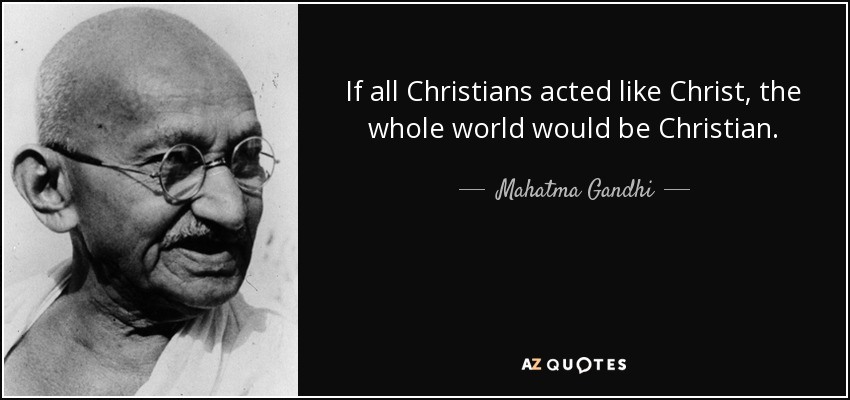
Similarly, holding Christ responsible for every aberrant act of Christians makes no sense since Jesus did not ask or command people to do terrible things or behave badly (see Beyond Belief – Did You Know Jesus Came to Start a Relationship, Not a Religion?). This would be tantamount to throwing my wife and me in jail if one of our kids broke the law. And yet, even the great Indian leader, Mahatma Gandhi fell into this trap:
Along the lines of the list above pertaining to how all the major religions have improved life on this planet, there’s a whole Wikipedia article describing the wide variety of ways Followers of Christ have made positive impacts on the trajectory of the world. In the interest of brevity, though, I will provide the link instead of trying to summarize the entire article: Role of Christianity in Civilization. All you have to do is ask yourself: whenever there’s a natural disaster or any other sort of crisis, which group of people generally gets there first to help those who are suffering? The church–Followers of Christ being the hands and feet of Jesus in the world.
So instead of holding Jesus responsible when his followers behave badly, people honestly investigating the veracity of following Christ should instead familiarize themselves with the things Jesus did command his followers to do, which included:
Many of the beatitudes, from the start of his Sermon on the Mount, describe the kind of attitude we should all have in relation to God and others–for example, be merciful and pure in heart; be peacemakers (Matthew 5:3-11)
Not only should we not murder, but we shouldn’t even be angry with one another (Matthew 5:21-26)
Not only should we not commit adultery, we shouldn’t even look lustfully at someone other than our spouse (Matthew 5:27-30)
These commands obviously set the bar for appropriate behavior quite high. Do I meet them? Not on my best day! Does any Follower of Christ meet them completely? Nope.
So then, why bother trying, if nobody can meet such high standards??
Here is where Gandhi got it right: because this is the way Jesus acted, and if all of his followers did the same, the whole world would be Christian.
And here’s the really great news for me and for all Followers of Christ: Jesus has done all of the really hard work–all of the impossiblework–for us. He lived a perfect life because we cannot. He died the punishing death we all deserve, sacrificing himself for us so that we could be restored into the relationship with God that he originally intended for us.
And here’s the truly amazing thing that so many people–those who are not followers of Christ–fail to grasp: God offers this extravagant gift of grace to them as well. Sadly, they do not recognize their need for it. My urgent prayer for you, if you fall into this category, is that you will realize this before it’s too late.












 Master's Canvas - Writing & Photography by David K. Carpenter